📅 Free webinar · 14 October, 11-11.30am BST (UK time)Will AI recommend your stores? Three moments that decide a saleSave your seat
Retail Digital Transformation: The Location Layer
Jean-Thomas Rouzin - Reading time : 11 min
Table of contents
Retail digital transformation is the reworking of a retailer's technology, data, and operating model to serve customers across online and physical channels. Most roadmaps fund a commerce platform, a new POS, a data warehouse, and an AI initiative - and quietly skip the location-data layer that connects online intent to a physical store. That gap is where omnichannel programs stall.
If your transformation deck has a slide for the commerce platform, a slide for data, and a slide for AI, but no slide for how customers find, choose, and reach your stores, you have already found the weakest link. The location-data layer is the plumbing between "I want this" online and "here is where you buy it" in the physical world. It rarely gets a budget line of its own, and that is exactly why omnichannel results underwhelm.
What retail digital transformation actually covers in 2026
Strip away the vendor language and retail digital transformation comes down to four workstreams that almost every board funds:
Commerce and channels. Replatforming ecommerce, unifying online and in-store carts, adding marketplaces and social selling.
Data and analytics. A customer data platform, a warehouse, and dashboards that finally join online behaviour to store sales.
Operations and supply. Order management, inventory visibility, click and collect, and delivery orchestration.
Intelligence and AI. Personalization, demand forecasting, and generative tools for content and service.
Each of these is real and each deserves funding. The problem is not what is on the list. The problem is a dependency that runs underneath all four and never gets named: spatial data and the operational APIs that use it. Fix the commerce platform without it and customers still cannot find the nearest stocked store. Build the data lake without it and your "single view of customer" has no reliable location on it. Ship the AI roadmap without it and your local pages stay invisible to the answer engines that now sit in front of search.
The layer most roadmaps leave out
Location intelligence used to mean static maps in a board pack: catchment zones drawn once a year, competitor sites scored at the store-opening committee. That reporting layer still matters. It is not the layer that moves this year's revenue.
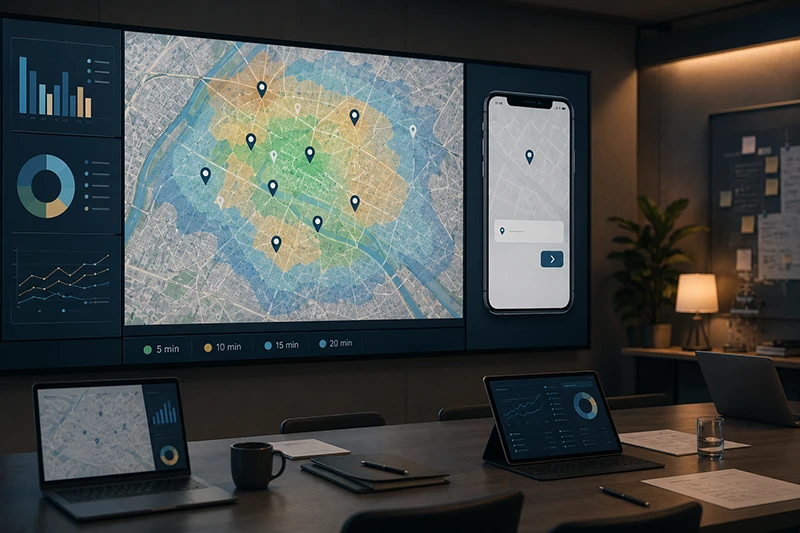
The layer that moves revenue is operational: address autocomplete and geocoding called from checkout, distance and isochrone ranking behind store search, map rendering in the app, and local pages built to rank on local intent. This is the layer retailers under-invest in, because it sits between teams. It is too technical for the marketing roadmap and too commercial for the platform team, so it falls through the middle. Meanwhile it is the exact layer the customer touches every time they search for a store, pick a collection point, or type an address.
Name it as its own workstream and two things happen. Budget stops being borrowed from whichever adjacent project has slack, and someone finally owns the outcome. Leave it unnamed and it stays everyone's assumption and no one's deliverable.
Four transformation initiatives that quietly run on location data
Here is the dependency made explicit. Every initiative on the left is already on most retail transformation roadmaps. The location-data capability in the middle is what it silently relies on, and the right column is what actually breaks when that capability is missing or bolted on late.
Transformation initiative
Location-data capability it depends on
What breaks if you skip it
Omnichannel / web-to-store
Store search, ROOFTOP-level geocoding, local pages
Customers cannot find the nearest stocked store; local pages fail to rank on local intent
Click and collect
Travel-time (isochrone) ranking, store selection, stock-by-location
Wrong store surfaced, unrealistic ready times, baskets abandoned at the collection step
Personalization
Geolocation context (region, timezone, proximity)
Offers ignore where the customer actually is; the "personalized" experience reads as generic
Checkout and delivery
Address autocomplete plus validation, geocoding
Failed deliveries, returns, and cart abandonment at the address field
Read the table as a decision-maker, not an engineer. Each broken outcome on the right is a revenue leak, and each one is usually blamed on the wrong owner. Cart abandonment at the address field gets logged as a UX problem. Weak local rankings get logged as an SEO problem. Failed deliveries get logged as a logistics problem. They share one root cause: the location-data layer was never funded as a capability.
The consequences are measurable. Better address capture and geocoding at checkout is repeatedly reported to lift mobile conversion by double digits - European marketplaces have publicly reported uplifts of up to +35% on mobile checkout after moving to modern autocomplete, an upper-bound, customer-reported figure rather than a guarantee. Location-aware store and product search is associated with add-to-cart lifts of up to +15% in customer-reported tests. And retailers that enrich local pages with real spatial context have reported up to +38% organic traffic on those pages (reference available under NDA, upper bound). Treat these as industry benchmarks that show the shape of the opportunity, not as promised results.
How to put the location-data layer on your roadmap
You do not need a moonshot. You need to treat spatial capabilities as things you either own, rent, or integrate - the same decision you already make for payments or search. Four capabilities cover the majority of retail use cases:
Store search and local pages. Let customers find the nearest relevant store from any entry point, and publish store and dealer pages with genuine spatial context so they rank and get cited. If you want the practical version of this, see how a modern store locator supports local growth.
Distance and travel time. Rank stores and collection points by real driving or walking time, not straight-line distance, using distance-matrix and isochrone data. In dense cities the two answers are rarely the same.
Address autocomplete and geocoding. Turn multi-field address entry into a single field that resolves to accurate coordinates, so checkout and delivery stop leaking orders. The engineering pattern here is the same one covered in two technical ways to implement a product locator.
Geolocation context. Use coarse, IP-level region and timezone signals to personalize the experience without collecting personal data.
Where you start depends on where you are bleeding. This is the fastest way to sequence the work:
Your situation
Where to start
Why
Hundreds of stores, weak web-to-store
Store search plus local pages
Shortest path from online intent to a physical visit
High mobile cart abandonment
Address autocomplete plus validation
Address entry is the highest-friction step on mobile
Marketplace or many listings
Travel-time (isochrone) ranking
Straight-line distance missorts results in cities
Cross-border EU retail
EU-hosted geocoding plus address validation
Complex markets such as the UK, Italy, and Spain need native handling
Two rules keep this honest. First, do not buy capability you will not integrate - an unused API is worse than no API because it still carries cost and false comfort. Second, pick the highest-friction customer moment and fix that one end to end before opening a second front. Click and collect is a common first choice because it forces store selection, stock, and routing to work together; the mechanics are covered in how click and collect flows depend on store selection.
Tools and where they fit
There is no single "location layer" product to buy, and treating this as a one-vendor decision is a mistake. The market splits into a few honest categories:
General mapping platforms - Google Maps Platform, Mapbox, HERE, TomTom, Azure Maps. Strong, general-purpose, and priced per request or per load; well suited to navigation and broad map use, less tuned to retail commerce flows.
Address-verification specialists - such as Loqate. These validate and correct an address after the user enters it. They complement a location platform rather than replace it.
Geofencing and engagement tools - such as Radar. Focused on triggers and notifications rather than the full search-to-store stack.
Commerce-focused location platforms - such as Woosmap, a European location intelligence platform used by 220+ enterprise clients across retail, logistics, and travel, which curates points of interest and addresses for commerce use cases and offers store search, distance and isochrone, and address APIs with a free tier on most APIs.
For a decision-maker the useful question is not "who is best" but "which of these do we own, rent, or integrate, and against which customer moment". A retailer fixing checkout friction and a marketplace fixing listing relevance will land on different combinations - and that is the correct outcome, not a failure to standardize. If the checkout moment is your priority, the operational detail is in five checkout practices that reduce address friction; if store discovery is, why a geolocation-driven locator matters for growth is the better starting point.
What happens to your customers' location data
Location is personal data, so the layer that handles it is a data privacy and security decision, not only a technical one. Every address a customer types and every store they search is a signal, and where that signal goes matters.
Be even-handed here. The major platforms (Google, Mapbox, and others) include terms that let them use end-user query data to improve their products, train models, or feed adjacent ecosystems; the exact wording varies by product and should be reviewed by your legal team before any migration. Google, for example, routes data through US infrastructure and operates services that compete with some of its own customers - a pattern the European Commission's Digital Markets Act rules address directly, and which the EU Digital Markets Act recognized as self-preferencing. None of this is an accusation; it is a governance trade-off to make with eyes open.
The transformation-era question is simple: for a European retailer moving customer data across a modernized stack, does your location provider's data posture help or hurt your obligations under the EU General Data Protection Regulation? Providers with EU-hosted infrastructure and no advertising business on the other side of the transaction change that answer. Make it a written criterion in the vendor decision, not an afterthought discovered at the security review.
Where location data is not the transformation lever
The honest counterpoint: location data is not the answer to everything, and a transformation program that treats it as a silver bullet will overspend. If your problem is assortment planning, pricing, or supply-chain forecasting, spatial APIs are supporting cast, not the lead. If you are a pure digital player with no physical footprint and no delivery to a physical address, most of this layer is optional. And indoor wayfinding inside individual stores is a specialist problem that sits outside what a commerce location layer is built for.
The point is not that location data is always the priority. It is that on omnichannel roadmaps it is almost always underweighted relative to the revenue it touches. Right-size it against the customer moments above, and stop there.
Frequently asked questions
It is the work of modernizing a retailer's technology, data, and ways of working so that online and physical channels operate as one experience for the customer. In practice it usually means a new commerce platform, unified data, modern operations such as click and collect, and AI-assisted personalization - underpinned by a location-data layer that connects online intent to physical stores.
Because omnichannel retail lives at the seam between online and physical, and location data is what stitches that seam. Store search, travel-time ranking, address capture, and local pages are the capabilities customers touch when they move from an online intent to a store visit or a delivery. Skip them and the rest of the transformation cannot pay off.
Look for symptoms owned by three different teams: high cart abandonment at the address field (UX), weak local search rankings (marketing), and failed deliveries or returns from bad addresses (logistics). When those three appear together, the shared root cause is usually an unfunded location-data layer.
Build only what is a genuine differentiator, which for most retailers is the customer experience layered on top, not the underlying spatial data and APIs. Maintaining global address graphs, geocoding accuracy, and routing is a full-time product commitment. Most retailers rent the capability and integrate it, reserving engineering time for the experience.
It can, depending on the provider. The risk is not the technology but where customer location data goes and who profits from it. Favor providers with EU-hosted infrastructure and no advertising business built on your customers' queries, and make data posture an explicit, written criterion in the vendor decision under the GDPR.
Start with the single highest-friction customer moment. For most store-based retailers that is either checkout address entry or web-to-store discovery. Fix one end to end - measure it, prove the lift, then fund the next capability from the result rather than from a big up-front bet.
Where to go next
Retail digital transformation succeeds or fails at the seam between the online intent and the physical store, and that seam is made of location data. Name the layer, give it an owner, and sequence the work against the customer moment that is leaking the most revenue today.
This analysis was written by Jean-Thomas Rouzin, CEO of Woosmap. Jean-Thomas leads a European location intelligence platform serving 220+ enterprise clients across retail, logistics, and travel, processing 28B+ location context calls per year with a 99.9% SLA on the Enterprise plan.