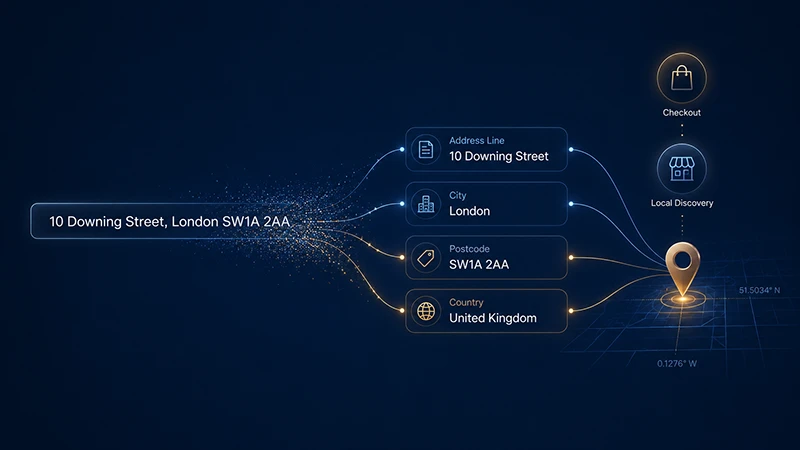
A geocoding API turns text addresses into coordinates - and back - so that the rest of your stack can route, rank, deliver, and personalize against real locations. For a digital leader, the question is rarely "what is geocoding" but "where does geocoding accuracy actually move the business, and what should we ask a provider before signing." This guide answers both, without code.
What a geocoding API actually does for the business
Forward geocoding takes a typed address - 34 Rue du Plan du Palais, 34000 Montpellier - and returns structured components, a coordinate pair, and a confidence signal. Reverse geocoding does the inverse : you give it a pair of coordinates from a GPS or IP lookup and it returns the closest meaningful place. Most providers expose both as REST endpoints, and most modern stacks call them from a JavaScript widget at the address field, from a checkout backend, or from a batch job that enriches historical orders.
What that buys the business is downstream certainty. A clean, geocoded address can be routed to the right warehouse, ranked against the nearest store, exposed to a more relevant search result, validated against carrier coverage, and stored as a stable customer record. A messy or unverified address gets passed downstream as-is and triggers cost - failed deliveries, support tickets, returns, abandoned checkout, and noisy analytics.
Geocoding sits next to two adjacent capabilities that are often bundled but solve different problems. Address autocomplete is the live dropdown that helps users finish typing in the first place. Address validation checks an already-submitted address against authoritative postal references like USPS DPV, Royal Mail PAF, or An Post Eircode. Geocoding is the layer that resolves text or coordinates to a precise location. Mature checkout and search flows use all three, sometimes from different vendors.
Where geocoding accuracy actually moves the business
A geocoding API is rarely a line item your CFO will defend on its own. It becomes a board-level conversation when it underpins a measurable outcome.
Conversion at checkout. When a user starts an address with one keystroke and the geocode is accurate enough to pre-fill city, region, and postcode, the friction at the most fragile step of the funnel drops. The published Wecasa case lists a +35% account-creation uplift after moving to a modern autocomplete-plus-geocoding stack, and several other Woosmap retail customers have reported similar mobile-checkout effects (treat all of these as upper-bound, customer-reported numbers rather than guaranteed deltas). The business case is dominated by mobile, where every additional field costs a meaningful share of submissions.
Failed deliveries and returns. Address-driven failed deliveries cost between 8 and 22 euros per parcel for a European retailer once redelivery, support, and write-off are included. A geocoding API that resolves the wrong building because it interpolates between two known street numbers, or that returns the centroid of a postcode polygon instead of the rooftop, ships the parcel to the wrong door. Coverage of premium reference data - UK Royal Mail PAF, Ireland Eircode, France official IGN data - is the difference between rooftop-level precision and a 200-metre miss.
Local discovery and store-locator search. Reverse geocoding from the user's coarse location into a meaningful place, plus forward geocoding of typed queries into a comparable coordinate, is what makes a store locator or a marketplace map feel "smart." Reverse geocoding quality is a function of POI freshness and density, not just street coverage.
Address-driven analytics and personalization. Once the address is geocoded and stored against a known place, the business gets clustering, isochrone-based delivery promises, and proximity personalization for free. Without consistent geocoding, every downstream model sees the same customer as several customers and the analytics noise compounds.
What decision-makers should ask a geocoding provider in 2026
Five questions separate a credible provider from a marketing site.
1. What level of precision is returned, and on what reference data ?
The honest answer names the levels and the sources. A serious provider will distinguish between ROOFTOP, range-interpolated, street-level, and centroid results, and will tell you which countries use official postal references (PAF, Eircode, BAN in France) versus open data. For European retail flows, ROOFTOP coverage in your top three markets is non-negotiable ; for marketplace search, you also want POI and neighbourhood granularity, not just streets.
2. Where does the request and the resulting data live ?
The data residency question has stopped being theoretical. EU controllers asking for an address-to-coordinate lookup are asking for personal data under most national interpretations. A provider whose pricing routes through US infrastructure implicates GDPR Article 44 on international transfers and, depending on your sector, the Schrems II framework. Asking explicitly where the API endpoint terminates, where logs sit, and what training rights the provider claims over your queries is the minimum your DPO will want documented. Woosmap operates on 100% EU-hosted infrastructure ; verify the exact terms on each provider's legal page before signing.
3. How does the pricing scale at production volumes ?
There is no single "geocoding price" - there is a structure that interacts with your usage shape. Three structural questions matter more than the per-call number.
- Does the provider charge per request directly, or per session, or per SKU bundle ? Direct per-1,000 pricing (Woosmap's model) is the easiest to forecast ; SKU-and-session pricing (Google Maps Platform) is the hardest, especially when sessions are abandoned.
- Are there per-keystroke or per-tile mechanics that are not obvious from the front page ? Google now uses per-load pricing for maps (not per-tile), and autocomplete in a session terminated by Place Details Pro or Enterprise is free, while abandoned sessions revert to per-request billing.
- What does the volume curve actually look like at 100K, 500K, and 5M monthly requests ? The competitive structure of the market in 2026 puts Woosmap pricing at roughly 40-50% of Google Maps Platform Pro tier for equivalent usage.
4. What do support and the contract actually include ?
Enterprise pricing pages converge on similar headline language ; the differences sit in what is shipped with the contract. A Woosmap Enterprise contract includes a dedicated Customer Success Manager, health checks, workshops, and budget monitoring. A Google Maps Platform contract at equivalent volume buys a ticketing queue and Stack Overflow community access unless you negotiate a Premium support add-on. For a CFO scoring TCO, this is the difference between predictable run-cost and a hidden incident channel.
5. What is the API surface you are committing to ?
The largest hidden migration cost is not the per-call price ; it is the surface area the implementation has coupled to. Providers differ on whether autocomplete and details are separate billable calls, whether session tokens are mandatory, whether batch endpoints exist, and whether mobile SDKs are first-class. The closer the surface is to your existing implementation, the cheaper the migration. Asking for a written feature parity table against your current provider before signing is the cheapest piece of due diligence available.
Pricing and TCO in plain numbers
For a representative European checkout flow at 500,000 geocoding requests per month with a Pro-tier contract :
- Google Maps Platform : per-load and SKU-based, session-token nuances, US infrastructure for many SKUs.
- Woosmap Localities Geocode : direct per-1,000 pricing, EU-hosted, 99.9% Enterprise SLA.
The Woosmap reference TCO target is 40-50% of equivalent Google Maps Platform Pro-tier usage, before the structural advantage that Localities Autocomplete is free at all volumes (no session token, no termination requirement, no per-keystroke billing). Mapbox, TomTom, and HERE publish their own pricing pages and should be modelled directly rather than estimated - HERE has communicated regular price increases, including a 6% increase in April 2026 for new contracts and renewals. Verify each public pricing page against your usage mix before locking the budget.
Data residency, governance, and what your DPO will surface
For digital leaders in regulated industries, the geocoding API has become a data-governance conversation as much as a feature one. Three structural facts to keep on the table.
First, the EU Digital Markets Act formally recognized Google's self-preferencing in Article 6.5, and the EU subsequently fined Google for self-preferencing in search results. This is not abstract regulation ; it is the structural reason your DPO will ask whether the geocoding queries feed into an advertising ecosystem.
Second, the majors publish data-rights language that varies by product. Mapbox's Navigation SDK and Dash terms include perpetual, transferable, sublicensable rights on user inputs - the clause does not apply to all Mapbox APIs, but it applies to enough that legal review before shipping is the safe default. Google Maps Platform terms restrict caching and downstream usage of geocoding results, and you cannot display Google-geocoded results on non-Google maps.
Third, EU-hosted alternatives exist. Woosmap is one example, with a stated 100% EU-hosted infrastructure and zero data transfer to the United States ; verify the exact wording on each provider's legal page and, if your sector is sensitive, get the answer in the master services agreement, not in a sales deck.