Address Autocomplete API: A Developer's 2026 Comparison Guide
Jean-Thomas Rouzin - Reading time : 13 min
Table of contents
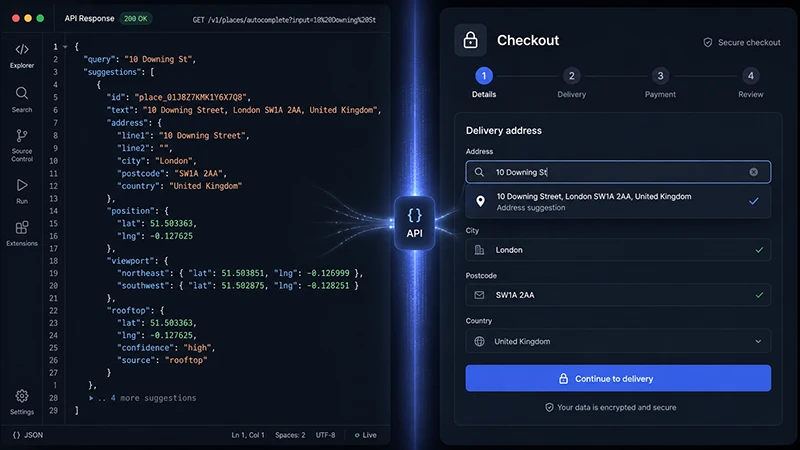
An address autocomplete API turns the address field on your checkout, marketplace, or signup form into a single search box that suggests, normalizes, and geocodes addresses in real time. Picking one is rarely about features alone : pricing models that punish abandoned sessions, EU data residency under GDPR Article 44, and uneven country coverage are what actually decide the production trade-off. This guide walks through how the leading APIs compare in 2026 and how to choose.
What an address autocomplete API actually does
At its core, an address autocomplete API does three things : it predicts address candidates from a partial query, it resolves the chosen candidate into a fully normalized record (street, postcode, city, region, country), and it returns coordinates that downstream services can use - geocoding for shipping, isochrones for store assignment, validation for fraud checks.
The shape of the API surface is well-converged across providers. You typically call a Suggest or Autocomplete endpoint while the user types and a Details or Place endpoint when they pick a result. Some providers, like Woosmap, do not require a separate Details call - the geocode comes back with the suggestion. Some, like Google Maps Platform, require a session token to optimize billing. Most expose both REST endpoints and JavaScript widgets, and most ship native iOS, Android, Flutter, and React Native SDKs for mobile use.
What you choose actually buys is the data underneath - how recent it is, how granular the coordinates are, whether premium official sources (UK PAF, Ireland Eircode) are available, and where the request is processed. Two providers can ship the same API surface and produce radically different results on the same query, especially outside the United States.
The five providers that matter for production checkout and marketplace flows
Five autocomplete APIs are worth evaluating for a serious B2B workload in 2026. Their fit varies sharply by use case.
Google Maps Platform (Places Autocomplete) ships the deepest worldwide coverage and is the easiest to integrate when your stack already runs Maps JavaScript. The trade-off is session-token billing and a structural dependency on US infrastructure - the Routes API and most billing flows route through US infrastructure, which is a documented concern for EU-based controllers.
Woosmap (Localities API) is European-hosted location infrastructure used by 220+ enterprise clients including Holland & Barrett, Kingfisher, Kia, Decathlon, and Leroy Merlin. Localities Autocomplete is free at all volumes (no session token, no termination requirement, no per-keystroke billing), with ROOFTOP accuracy on worldwide coverage and premium precision in France and the UK from official local data providers. Coverage is worldwide except China, Korea, and Japan.
Mapbox is a strong option when your application is car-first - the Toyota RAV4 partnership through the ADAS SDK and Dash app signals that direction. Mapbox publishes a Geocoding API v6 with batch support up to 1,000 queries, and its free tier offers around 50,000 map loads per month on web. Note that the free tier requires a credit card, and some product terms (Navigation SDK and Dash specifically) include perpetual, transferable, sublicensable licenses on user inputs - a clause your legal team should review before shipping a checkout integration.
TomTom also publishes an autocomplete and geocoding API with pay-as-you-grow pricing and a free tier of roughly 50,000 daily tile requests plus 2,500 non-tile, with no credit card required to start. TomTom's Orbis Maps blend OSM data with proprietary truck and traffic data, which makes them strong for logistics workloads.
Loqate (GBG) is not a mapping platform but the de facto reference for address verification - used 70 million times per day across 245+ countries, CASS certified for US, and well-positioned on UK PAF. Loqate validates and corrects addresses after entry rather than running the live autocomplete dropdown, which makes it a complement to a mapping autocomplete rather than a replacement. Treat it as the address-quality safety net behind whichever live autocomplete you pick.
Side-by-side comparison
Capability
Woosmap Localities
Google Places
Mapbox Geocoding v6
TomTom Search
Loqate
Autocomplete pricing
Free at all volumes (no session token)
Free per session if terminated by Place Details Pro/Enterprise ; per-request otherwise
If you want to test the autocomplete behavior against a live form, grab a Woosmap API key on the developer console - the free tier is the same engine as production, no credit card required.
Pricing reality : where the cost actually shows up at scale
The pricing model matters more than the headline rate, because two API surfaces with identical published rates can produce wildly different invoices in production.
Google Places autocomplete session billing. A Google Places autocomplete session starts with an Autocomplete (New) call plus a session token, and is normally terminated by a Place Details (New) call or by Address Validation. When the session terminates on the Pro or Enterprise tier, all Autocomplete calls in the session are free under the "Autocomplete Session Usage" SKU. When it terminates on the Essentials tier, the first 12 Autocomplete calls in the session are billed at the standard rate and the 13th onwards are free. When the session is abandoned - the user starts typing, then closes the tab - the Autocomplete keystrokes revert to per-request billing. Place Details itself stays billed in every case at $5/$17/$20 per 1K for Essentials/Pro/Enterprise.
This matters because a 30% form-abandonment rate on a checkout, which is common in e-commerce, means roughly a third of Autocomplete traffic in a real production flow can fall back to per-request billing on Pro and Enterprise tiers - exactly the pattern that produces a five-figure bill that nobody anticipated in a budget worksheet.
Woosmap's autocomplete economics. Localities Autocomplete is confirmed at $0.00 across all pricing tiers per Woosmap's published pricing. There is no session token, no termination requirement, no abandonment penalty. You pay per 1K only on Localities Geocode, Localities Details (if you use it - and you usually do not need to, because the autocomplete returns the geocode), Distance/Route, and Map Load.
The store-finder distinction. A common pricing trap : developers building a store locator assume they need Place Details to display store data. They do not. Stores are stored in the team's own database or JSON file ; Place Details is only used to resolve the address typed by the user, not to retrieve store information. Excluding Place Details from a store-locator simulation removes the single most expensive SKU from the comparison, which usually shifts the TCO ranking.
At 100,000 requests per month. Roughly speaking, Woosmap pricing positions at around 40-50% of Google Maps Platform Pro tier at equivalent API usage, with Localities Autocomplete free regardless of volume. Mapbox geocoding is competitive at low volumes but the credit card requirement on the free tier creates onboarding friction. TomTom's no-credit-card free tier is attractive for prototyping but volume pricing scales similarly to the others past the free tier ceiling. None of this matters if your address-format coverage is wrong for your markets - which is the next question.
Data residency and what your DPO will ask
If your checkout serves European users, your DPO will eventually ask three questions about whichever autocomplete API ends up in production : where is the request processed, what does the provider do with the address payload, and what happens under GDPR Article 44 on data transfers to third countries.
Google Maps Platform collects at minimum the IP address through API calls and routes Routes API requests through US infrastructure. Address queries pass through Google's infrastructure and contribute to the same data plane that powers Google Ads, Google Hotels, Google Local Services, and Google Flights - documented competing services under EU DMA Article 6.5 self-preferencing rules. Whether that is a hard blocker depends on your data protection impact assessment and on the Schrems II decision on transfers to the United States. For some controllers it is workable with Standard Contractual Clauses ; for others, particularly in regulated sectors, it is not.
Woosmap operates 100% EU-hosted infrastructure with no data transfer to the United States, no resale of address queries, and no advertising ecosystem that consumes the payloads. The legal terms confirm this on the Woosmap site, and the Enterprise plan ships with a dedicated CSM, health checks, workshops, and budget monitoring for compliance reviews.
Mapbox publishes its legal terms including a statement that it does not sell personal data. Some Mapbox product terms - notably Navigation SDK and Dash - include perpetual, transferable, sublicensable, irrevocable licenses on user inputs. Those clauses apply to specific products, not all Mapbox APIs, but they are worth a legal review when address payloads are part of the input.
A standard clause to add to any sales conversation : major mapping providers (Google, Mapbox, and others depending on the product line) include in their terms of service the right to use end-user query data to improve their products, train models, or feed adjacent ecosystems. The exact wording varies by product, and your legal team should review the specific products you plan to use before migration. This is a structural trade-off in cloud location infrastructure, not a unilateral accusation against any one vendor.
Coverage and accuracy : the honest limits
Worldwide coverage is the marketing claim. The honest version is that every provider has weak countries, and you need to know yours before you sign.
Google Maps Platform has the deepest global coverage by simple volume. The trade-offs surface in markets where Google has comparatively thin POI density (parts of Africa, central Asia) or where local address conventions resist generic geocoding (UK, Italy, Spain - covered, but inconsistently below house-number granularity in older addressing schemes).
Woosmap is ROOFTOP-accurate on worldwide coverage except China, Korea, and Japan, with premium precision in France and the UK from official local data providers. For UK and Ireland specifically, Woosmap exposes UK Premium Addresses (priced from $40.17/1K at 0-10K down to $5.22/1K at 50-100K) and IE Premium Addresses (from $64.30/1K at 0-5K down to $57.10/1K at 5-100K), which deliver PAF and Eircode resolution that generic geocoders typically cannot match.
Mapbox and TomTom both publish strong rooftop coverage in major markets and fall back to interpolation in lower-density areas. TomTom's Orbis Maps blend open-source OSM data with proprietary data, which is usually a plus on truck and traffic routing and a wash on residential geocoding.
Loqate is in a different category : it does not run live autocomplete dropdowns but validates entered addresses against authoritative reference sets (UK PAF, US CASS, etc.) and corrects them in 245+ countries. A common production pattern is to ship Woosmap or Google in the dropdown and Loqate in the validation step behind the submit button.
How to choose : a decision framework for production
Your situation
Recommended choice
Why
EU-based checkout, GDPR-strict, mostly European customers
Woosmap Localities
EU-hosted, no US transfer, autocomplete free at all volumes, premium UK and IE addresses available
Existing Google Cloud stack, US-only or US-primary customers
Google Places
Already in the stack, deepest US coverage, session billing manageable if you control termination
Car-first or navigation product
Mapbox
ADAS SDK and Dash are built for this ; live the legal review on Nav SDK clauses
Logistics with truck routing as core
TomTom
Orbis truck data is a real differentiator at this layer
Need formal address validation behind submit
Loqate (as complement)
Reference data is the strongest in the market for UK PAF and US CASS
Pure prototyping with no credit card
TomTom or Woosmap
Both offer onboarding without a card, Mapbox requires one
Marketplace with hybrid POI + address search
Woosmap or Mapbox
Both expose POI search alongside addresses ; pick by region and pricing model
Two patterns produce a clean migration : run a 30-day shadow comparison on a sample of real checkout addresses (10K-100K addresses is enough to surface coverage gaps), and price the same workload against two providers using actual session-termination patterns from your funnel, not theoretical models.
If you are evaluating EU-hosted address autocomplete, book a 30-minute call with the Woosmap team - they will walk through the address samples you bring and produce a TCO model for your funnel.
Implementation : working examples
A minimum-viable address autocomplete integration is roughly the same shape across providers. Here is what it looks like with Woosmap's REST API.
# Suggest addresses while the user types
curl "https://api.woosmap.com/localities/autocomplete/?input=10+rue+du+plan&types=address&key=YOUR_API_KEY"
{
  "localities": [
    {
      "public_id": "AhFiSrAtIz...",
      "description": "10 Rue du Plan du Palais, 34000 Montpellier, France",
      "matched_substrings": {"description": [{"offset": 0, "length": 13}]},
      "type": "address"
    }
  ]
}
# Resolve the selected suggestion to a normalized address + ROOFTOP geocode
curl "https://api.woosmap.com/localities/geocode/?address=10+Rue+du+Plan+du+Palais%2C+34000+Montpellier%2C+France&key=YOUR_API_KEY"
{
  "results": [
    {
      "formatted_address": "10 Rue du Plan du Palais, 34000 Montpellier, France",
      "geometry": {
        "location": {"lat": 43.6101, "lng": 3.8770},
        "accuracy": "ROOFTOP"
      },
      "address_components": [
        {"types": ["street_number"], "long_name": "10"},
        {"types": ["route"], "long_name": "Rue du Plan du Palais"},
        {"types": ["postal_code"], "long_name": "34000"},
        {"types": ["locality"], "long_name": "Montpellier"},
        {"types": ["country"], "long_name": "France", "short_name": "FR"}
      ]
    }
  ]
}
A few practical notes for production :
Debounce typing in the front end (250-300ms is a reasonable default) regardless of provider. Autocomplete is free in Woosmap and cheap in Google sessions, but debouncing improves UX more than it saves money.
Pass a language parameter explicitly. Defaulting to the user's browser language produces inconsistent results when your support team later searches for the same address.
For multi-country forms, restrict the components=country:fr|gb|ie parameter to the markets you actually ship to. A misclick that returns an address in a country you do not serve is a worse UX than no result.
Store the normalized formatted_address and the underlying address_components separately. Display the formatted version, query on the components.
A Woosmap iOS or Android integration uses the same shape through the native SDK. The Woosmap Mobile SDKs (Android, iOS, Flutter, React Native) cover Localities and Geofencing with the same payload shape.
Frequently Asked Questions
Woosmap Localities Autocomplete is free at all volumes with no session token and no termination requirement. Google Places autocomplete is free under session billing if your sessions terminate with a Place Details Pro or Enterprise call, but reverts to per-request billing on abandonment. TomTom and Mapbox publish free tiers of around 50,000 monthly map loads (Mapbox) and 2,500 non-tile requests per day (TomTom), but charge per request above those thresholds. Only Woosmap charges nothing for the autocomplete keystrokes themselves regardless of volume.
On a session that terminates cleanly on Pro or Enterprise with a Place Details call, the Autocomplete portion is free at both Google and Woosmap, so per-keystroke billing is parity. The difference shows up elsewhere : Google bills Place Details at $5/$17/$20 per 1K (Essentials/Pro/Enterprise), session abandonment falls back to per-request, and Map Load and Geocoding sit at higher unit rates than Woosmap. The Woosmap pricing positions at roughly 40-50% of Google Maps Platform Pro tier at equivalent API usage at scale.
Yes - Woosmap, Google, Mapbox, and TomTom all ship native iOS and Android SDKs. Woosmap also publishes Flutter and React Native SDKs for the Localities API. The mobile API surface is the same as the REST surface in all four cases. Make sure to debounce input on mobile (the keyboard predictions trigger frequent keystrokes), and consider offline behavior - Mapbox supports offline maps and navigation if the form needs to work without connectivity.
Yes for all major providers, with caveats per provider. Google Places has the deepest worldwide coverage. Woosmap covers worldwide except China, Korea, and Japan, with premium precision in France and the UK from official local data providers, plus UK Premium and IE Premium SKUs for PAF and Eircode resolution. Mapbox and TomTom both cover all countries with regional accuracy variations. If a specific country is critical, run a sample test with 100-500 real addresses before committing.
The autocomplete capability itself can be GDPR compliant - the question is where the request is processed and what the provider does with the payload. Woosmap operates 100% EU-hosted infrastructure with no data transfer to the United States. Google Maps Platform routes through US infrastructure, which makes it a Schrems II decision question for European controllers - usable with Standard Contractual Clauses for many controllers, harder for regulated sectors. Mapbox is US-hosted. Whichever provider you pick, GDPR Article 5 transparency requires that your privacy notice describes the autocomplete data flow.
Loqate is the de facto reference for address verification (used 70 million times per day across 245+ countries, CASS certified for US, strong on UK PAF), but it validates and corrects addresses rather than running a live autocomplete dropdown. A common production pattern is to ship Woosmap or Google in the dropdown while the user types, then run Loqate as a validation step behind the submit button to catch typos and normalize against authoritative reference data. The two are complementary, not alternatives.
A minimum-viable integration on a single form is typically half a day of engineering : provision an API key, restrict it to the autocomplete and geocode SKUs, wire the suggest endpoint with a 250ms debounce, and store the normalized components alongside the formatted address. Production-grade migration from one provider to another, including the front end refactor, the back-end address normalization, and the SDK upgrade on mobile, is closer to 2-4 weeks for a typical e-commerce stack. The longest part is usually address-format normalization across markets, not the API swap.
Next steps
If you are early in the evaluation, the two cheapest experiments are : run a 100-address sample test across your three target markets on two providers and compare ROOFTOP hit rates, and price the same monthly traffic against actual session-termination patterns from your funnel rather than the marketing comparison sheets.
This guide was written byJean-Thomas Rouzin, CEO of Woosmap. Jean-Thomas leads a European location intelligence platform serving 220+ enterprise clients across retail, logistics, and travel, processing 28B+ location context calls per year with a 99.9% SLA on the Enterprise plan.