Address Validation API: A Developer's 2026 Comparison Guide
Jean-Thomas Rouzin - Reading time : 14 min
Table of contents
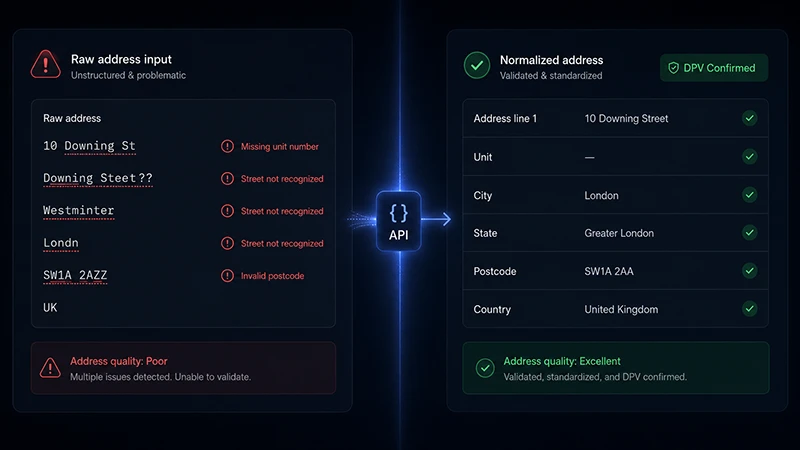
An address validation API checks that an address actually exists, normalizes it against an authoritative reference set, and tells your back end whether the carrier will deliver to it. It is not the same problem as autocomplete - autocomplete predicts what the user is typing, validation confirms what they submitted - and the two APIs are usually different vendors. This guide compares the five providers that matter for production in 2026 and how to pick.
What an address validation API actually does
Address validation answers three questions about an address that an autocomplete dropdown cannot. Is the address parseable into clean components - street number, street name, unit, postcode, locality, region, country ? Does it match a row in an authoritative reference data set (USPS DPV for the United States, Royal Mail PAF for the United Kingdom, An Post Eircode for Ireland, AusPost for Australia, La Poste for France) ? And, where the data set carries it, is the address flagged as deliverable - that is, the carrier currently delivers mail or parcels to that address ?
The output is a structured record with a verdict, not a list of suggestions. A typical response from any of the major validation APIs in 2026 carries the normalized components, a verdict (verified, partial, unverified), a deliverability flag where the reference data supports it (DPV: Y, DPV: N, vacant, secondary missing), and a corrections diff that shows what the API changed from the submitted version - a corrected postcode, a missing unit number, a spelling fix on the street name. The address that comes back is the address you should store and the address the carrier should see, not the address the user typed.
This is a structurally different problem from autocomplete. The pricing model is different (per-record, sometimes with batch discounts, rather than free-by-session keystrokes), the latency budget is different (one synchronous call at submit, not a debounced dropdown), and the deliverability data is different (postal-authority reference data, not POI density). If you arrived here looking for the live dropdown UX, see our companion guide to address autocomplete APIs - the two together are how production checkout flows handle addresses.
The five providers that matter for production in 2026
Five address validation APIs are worth evaluating for a serious B2B workload in 2026. Their strength varies sharply by geography, by reference-data source, and by whether the validation runs synchronously in the checkout or as a batch cleanse against a warehouse.
Loqate (GBG) is the global reference for address validation, used 70 million times per day across 245+ countries and CASS Certified for the United States. Loqate validates and corrects addresses after entry rather than running a live autocomplete dropdown. Its deepest assets are PAF for the UK, Eircode for Ireland, CASS for the US, and a normalized address layer across 245+ countries that is hard to replicate from generic geocoding sources. Loqate is on-premise and cloud, with an enterprise model that tends to suit organizations with established procurement processes.
Google Address Validation API is Google's dedicated validation endpoint, separate from Geocoding and Places. It returns a verdict (addressComplete, hasInferredComponents, hasUnconfirmedComponents, hasReplacedComponents), a USPS-DPV flag for US addresses, and a normalized postalAddress. It is well-priced at $17/1K (April 2026 published pricing) and is the easiest to integrate when your stack already runs Google Maps Platform. The trade-offs are US infrastructure routing - relevant under GDPR Article 44 for EU controllers - and the same self-preferencing exposure that the EU DMA Article 6.5 ruling describes for Google's broader products.
Smarty is the US specialist - CASS Certified by USPS, with a per-record API priced from $99 for 5,000 lookups up to enterprise tiers. Smarty is the canonical choice when the workload is US-only and the team wants the fastest path to DPV-confirmed addresses. International coverage exists (Smarty International) but is not the strength of the platform.
Melissa is the enterprise full-stack data quality vendor with address validation as one product among many (name validation, phone validation, identity verification, deduplication, data enrichment). Melissa's Global Address Verification covers 240+ countries with CASS Certified for the US and PAF licensed for the UK. It tends to win RFPs where the broader data-quality stack matters as much as address itself.
Woosmap is European location infrastructure with validation-grade data exposed through premium SKUs - UK Premium Addresses (PAF-licensed) and Ireland Premium Addresses (Eircode-licensed) on Pro and Enterprise plans, with 100% EU-hosted infrastructure and 220+ enterprise clients including Holland & Barrett, Kingfisher, Kia, Decathlon, and Leroy Merlin. Woosmap does not run a CASS workflow against USPS, so a pure-US workload usually points at Smarty or Google. For European and UK / Ireland-heavy workloads where data residency under GDPR matters, Woosmap is the same engine that already runs the autocomplete and geocoding flows on the checkout, with the validation step running against the same EU-hosted data plane.
Side-by-side comparison
Capability
Loqate
Google Address Validation
Smarty
Melissa
Woosmap
Primary geography
Global, 245+ countries
Global (US-DPV strongest)
US-first (Smarty Intl. for global)
Global, 240+ countries
EU + UK + IE (premium SKUs)
US CASS Certified
Yes
DPV via USPS data
Yes (CASS Certified)
Yes
No (use Smarty/Google for US-CASS workloads)
UK PAF
Yes (licensed)
Indirect
Limited (Smarty International)
Yes (licensed)
Yes (UK Premium Addresses)
IE Eircode
Yes (licensed)
Indirect
Limited
Yes
Yes (IE Premium Addresses)
Per-record API pricing
Volume tier (enterprise quote)
$17/1K (April 2026 published rate)
From $99 for 5K lookups
Tiered (enterprise)
UK Premium $40.17/1K (0-10K) sliding to $5.22/1K (50-100K) ; IE Premium $64.30/1K (0-5K) to $57.10/1K (5-100K)
If you want to run validation alongside an EU-hosted autocomplete on the same checkout, open a free Woosmap developer account and call Localities Geocode against the same address you ran through Localities Autocomplete - the free tier covers 10,000 requests per month.
Validation pricing reality : where the cost actually shows up
Pricing for address validation looks simple in vendor sheets and surprises teams in production for three reasons that are worth pricing into the comparison.
Per-record billing has no session token. Unlike autocomplete, where Google's session billing makes the keystrokes free under a terminated session, validation is unconditionally per record. Every submitted address is one billable call, whether the user finished the checkout or abandoned at the payment step. A funnel that validates the address right after the user picks an autocomplete suggestion - which is the recommended pattern for catching typos and missing units - generates roughly one validation call per checkout attempt, not one per completed checkout. At a 30% checkout-abandonment rate, that means about 30% of validation traffic produces no revenue but still bills.
Premium reference data carries a premium price. Loqate, Melissa, and Woosmap all charge more for PAF-grade UK addresses and Eircode-grade IE addresses than for component-only normalization. Woosmap's UK Premium Addresses are $40.17 per 1K at the 0-10K tier, falling to $5.22 per 1K at the 50-100K tier ; IE Premium Addresses are $64.30 per 1K at 0-5K, falling to $57.10 per 1K at 5-100K. Loqate's UK and IE tiers are similar in shape (enterprise-quoted in the public sheets). If your traffic is mostly UK with a long tail outside, run the math on the premium SKU before assuming a flat per-call rate.
Batch validation is usually cheaper but operationally different. Most of the providers offer batch endpoints at meaningfully lower unit cost - useful for cleansing an existing address warehouse but operationally awkward for the real-time checkout case. The batch SKUs are a TCO win for marketing-database cleanse jobs and a poor fit for the synchronous "is this address deliverable" call in the checkout funnel. Two SKUs for two workflows is the typical pattern.
Google's $17 per 1K (April 2026 published) for Address Validation is competitive on raw cost, especially for US-heavy workloads, and includes USPS DPV inline. Watch the included monthly credit on the Google Cloud billing account if you mix Address Validation with Maps Platform : the credit is shared across the account, so a heavy Maps Load month can swallow it before the validation calls land.
If you are evaluating GDPR-strict address validation, book a 30-minute call with the Woosmap team - they will walk through the validation-versus-autocomplete split and produce a TCO model for your specific country mix.
What "validated" actually means : DPV, CASS, PAF, Eircode
The word "validated" hides a substantial taxonomy. Two APIs can both return a successful verdict on the same address and mean different things by it.
USPS DPV (Delivery Point Validation) confirms that the address corresponds to an actual delivery point in the USPS database. DPV is the deepest US-specific deliverability check. CASS Certification (Coding Accuracy Support System) is the USPS process that certifies a software product as capable of standardizing and DPV-confirming US addresses. Google Address Validation, Smarty, Loqate, and Melissa all return USPS DPV flags for US addresses ; Woosmap does not.
Royal Mail PAF (Postcode Address File) is the UK authoritative source. PAF carries every deliverable address in the UK and is licensed by Royal Mail to data resellers. Loqate, Melissa, and Woosmap (via UK Premium Addresses) license PAF. Generic geocoders that scrape Google or OSM can return UK addresses but cannot return PAF-confirmed status.
An Post Eircode is the Irish equivalent, a per-address code that uniquely identifies every Irish delivery point. Eircode is licensed similarly to PAF. Loqate, Melissa, and Woosmap (IE Premium Addresses) license Eircode.
La Poste, AusPost, Canada Post, and other national authorities run similar systems. Loqate and Melissa have the deepest coverage across these ; the other vendors cover them less consistently. If your shipping markets include any of these, ask vendors for their reference-data source by country - and accept "we use a third-party aggregator" as an answer that is meaningfully different from "we license directly".
A practical implication : a validation API can return "verified" for an address that is structurally correct (parseable, plausible postcode) but is not in the postal authority's reference data set. That address may still fail at the carrier. Insist on the deliverability flag in the response, not just the verdict.
Data residency and what your DPO will ask
The data residency question is sharper for validation than for autocomplete, because the validation payload typically carries the full address plus name, phone, and email - a richer personal-data record than the address fragments that flow through autocomplete.
GDPR Article 44 restricts transfers of personal data to third countries, and the Schrems II decision made it materially harder to rely on Standard Contractual Clauses for transfers to the United States. A validation call that ships an EU customer's full address + name + phone + email to a US-hosted endpoint is a higher-risk transfer than a keystroke-level autocomplete call. The DPIA mathematics are different.
Google Address Validation runs on Google Cloud infrastructure and inherits the same routing posture as the rest of Maps Platform. Smarty and the broader Google stack are US-hosted. Loqate and Melissa publish EU options. Woosmap operates 100% EU-hosted with no data transfer to the United States.
A standard clause to add to any sales conversation : the major US-hosted address-validation providers may include in their terms of service the right to use submitted address data to improve their reference sets, train normalization models, or operate adjacent products. The exact wording varies by product, and your legal team should review the specific products you plan to use before migration. The takeaway is not that one provider is "evil" - it is that validation payloads are richer than the autocomplete payloads and the data-governance review should be more careful.
Coverage and accuracy : the honest limits
The marketing claim is "global coverage". The production reality is per-country, per-reference-data-source, and uneven.
United States : Smarty is the deepest CASS Certified specialist, Google Address Validation returns clean USPS DPV inline, Loqate and Melissa carry CASS certification too. Any of the four will deliver acceptable US validation ; pick on price, sync vs batch ergonomics, and how well the rest of the platform fits.
United Kingdom and Ireland : Loqate, Melissa, and Woosmap license PAF and Eircode directly. The PAF-licensed providers will return BFPO, PO Box, and "GIR 0AA" edge cases correctly ; an unlicensed geocoder will not. For a UK-heavy workload, do not accept a generic geocoder as "validation" - run a sample test against 100 known-edge addresses (BFPO addresses, Channel Islands, GIR 0AA Girobank legacy, and Northern Ireland).
Continental Europe : France (La Poste), Germany (Deutsche Post), Spain (Correos), Italy (Poste Italiane) all have national reference sets but the licensing model is patchier than UK or US. Vendors typically aggregate from a mix of national sources. For France specifically, Woosmap exposes premium precision in France from official local data providers.
Edge cases that catch every provider : new-build developments not yet in postal-authority reference data ; demolished addresses still in the data ; multi-occupancy buildings where unit numbers are submitted in fields the API does not expect ; military and diplomatic addresses (BFPO, APO/FPO). A validation API can return "verified" for a structurally plausible address that is brand new and not yet in PAF - the carrier will then bounce it.
How to choose : a decision framework for production
Your situation
Recommended choice
Why
US-only checkout, CASS / DPV critical
Smarty or Google Address Validation
Both CASS-grade ; pick Smarty for pure US-first product, Google for existing GCP stack
Global SaaS with deep international footprint
Loqate
Licensed coverage across 245+ countries with consistent verdict shape
Enterprise needing broader data quality (name, phone, email validation)
Melissa
RFP-friendly full-stack with address as one product among many
EU-based checkout, GDPR-strict, UK / IE / FR core markets
Woosmap
100% EU-hosted ; UK Premium PAF + IE Premium Eircode SKUs ; validation alongside autocomplete on the same engine
You already ship Woosmap autocomplete and want validation on the submit
Woosmap
Same key, same SDK, same data-residency story across the funnel
Existing Google Cloud stack, US-primary
Google Address Validation
Lowest integration friction with GCP-native auth
Batch cleanse of a 10M-address warehouse
Loqate batch or Melissa batch
Batch SKUs are meaningfully cheaper per record than sync endpoints
Need both autocomplete dropdown and validation behind submit
Pick provider per layer
Autocomplete and validation are different problems ; do not force one vendor to do both unless it is genuinely best for both
Two patterns produce a clean migration : run a country-by-country sample comparison on 500 known-good and 100 known-edge addresses for your top three markets, and price the same monthly volume across two providers using the actual sync-vs-batch mix from your funnel rather than the marketing comparison sheets.
Implementation : working examples
A minimum-viable address-validation integration sits behind the form submit, after the user has picked an autocomplete suggestion. Here is what it looks like when Woosmap drives the normalization step.
# Normalize and verify a submitted address against the EU-hosted geocoder
curl "https://api.woosmap.com/localities/geocode/?address=10+Rue+du+Plan+du+Palais%2C+34000+Montpellier%2C+France&components=country%3Afr&key=YOUR_API_KEY"
{
  "results": [
    {
      "formatted_address": "10 Rue du Plan du Palais, 34000 Montpellier, France",
      "geometry": {
        "location": {"lat": 43.6101, "lng": 3.8770},
        "accuracy": "ROOFTOP"
      },
      "address_components": [
        {"types": ["street_number"], "long_name": "10"},
        {"types": ["route"], "long_name": "Rue du Plan du Palais"},
        {"types": ["postal_code"], "long_name": "34000"},
        {"types": ["locality"], "long_name": "Montpellier"},
        {"types": ["country"], "long_name": "France", "short_name": "FR"}
      ]
    }
  ]
}
# Validate a US address through Google Address Validation API
curl -X POST "https://addressvalidation.googleapis.com/v1:validateAddress?key=YOUR_API_KEY" \
  -H "Content-Type: application/json" \
  -d '{
    "address": {
      "regionCode": "US",
      "addressLines": ["1600 Amphitheatre Pkwy, Mountain View, CA 94043"]
    }
  }'
Validate at submit, not on every keystroke. Autocomplete handles the keystroke layer ; validation is a single synchronous call at form submit.
Store the corrections diff. The address the user typed and the address the carrier should see are not always the same, and the diff is the audit trail for support tickets.
Pass the country code explicitly via the equivalent of components=country:XX. A misclassified country is the most common silent failure mode in cross-border checkouts.
Treat the deliverability flag as the source of truth, not the verdict. A "verified" verdict with DPV: N is a structurally valid but undeliverable address.
For high-stakes shipments, layer validation behind an external deliverability signal - a phone number, a delivery time-window confirmation, or a delayed retry. No validation API is a substitute for picking up the phone.
Frequently Asked Questions
Autocomplete predicts what the user is typing while they type, returning a list of candidate addresses that the user picks from. Validation confirms what the user submitted, returning a verdict, a normalized form, and a deliverability flag. The two are usually different APIs and often different vendors. The production pattern is to run autocomplete during typing to reduce typos at the source, then validation behind the submit button to catch the typos that slipped through and to confirm deliverability against the postal authority's reference data set.
Accuracy depends on the country, the reference data set, and the address itself. For the US, CASS Certified providers (Smarty, Google, Loqate, Melissa) deliver USPS-DPV-grade accuracy on addresses in the USPS database - typically high-90s percent on settled addresses. For the UK, PAF-licensed providers (Loqate, Melissa, Woosmap) cover the licensed PAF database, which is the closest thing to ground truth. New-build addresses, demolished addresses, and edge cases (BFPO, PO Box, GIR 0AA) are where accuracy degrades fastest. Run a country-by-country sample test with real edge addresses from your business before signing.
The capability is GDPR-compatible ; the question is where the validation request is processed and what the provider does with the address payload. A validation call carries the full address plus typically name, phone, and email - a richer personal-data record than autocomplete. Under GDPR Article 44 and the Schrems II decision, transfers of that record to US-hosted infrastructure require Standard Contractual Clauses and a defensible DPIA. EU-hosted providers (Woosmap, Loqate and Melissa with their EU options) remove that question. Whichever provider you pick, your privacy notice must describe the address-validation data flow.
No. Validation is per-record-billed and synchronous by design. The recommended pattern is to run autocomplete during typing (cheap or free per keystroke, depending on provider) and validation once at submit. Validating per keystroke produces a five-figure monthly bill on a moderate-traffic checkout and adds latency that the user perceives.
It substantially reduces them but does not eliminate them. Validation catches structurally invalid addresses, missing unit numbers, and addresses not in the postal authority's reference set. It does not catch correctly-typed addresses that are temporarily undeliverable (the resident moved, the carrier is striking, the address is new and not yet in the reference data). For high-value or perishable shipments, layer validation behind a phone number, a delivery-window confirmation, or a parcel-locker fallback.
Sometimes - if the same vendor genuinely has the best fit for both. The autocomplete leader for your geography is not always the validation leader, and forcing one vendor to do both can produce worse outcomes than picking per layer. The honest answer is two vendors are usually fine, three is one too many, and the deciding factor is whether your team can operate two integrations cleanly. For an EU-strict workload, Woosmap covering both is a clean single-vendor story ; for a US-first workload, Google or Smarty + a separate autocomplete is more common.
A minimum-viable integration on a single checkout submit is typically half a day to a day of engineering : provision an API key, restrict it to the validation SKU, wire the submit hook to call the validation endpoint, parse the response into the normalized address, and store the corrections diff. Production-grade rollout including A/B testing the corrections UI, the support-ticket flow for false positives, and the batch-cleanse job on the existing warehouse is usually 2-4 weeks.
Next steps
If you are early in the evaluation, the two cheapest experiments are : run a 500-address country-by-country sample against two providers and compare verdicts and deliverability flags side by side, and price the same monthly volume against your real autocomplete-to-validation conversion ratio (typically 100% of completed-form attempts run validation, not just successful checkouts).
When you are ready to test, create a free Woosmap developer account - the free tier covers 10,000 monthly requests on Localities Geocode, and UK Premium and IE Premium Addresses are available on Pro and Enterprise plans. The Woosmap Localities API reference covers the full endpoint surface.
This guide was written byJean-Thomas Rouzin, CEO of Woosmap. Jean-Thomas leads a European location intelligence platform serving 220+ enterprise clients across retail, logistics, and travel, processing 28B+ location context calls per year with a 99.9% SLA on the Enterprise plan.