📅 Free webinar · 14 October, 11-11.30am BST (UK time)Will AI recommend your stores? Three moments that decide a saleSave your seat
MapLibre Alternatives (2026): Library vs Managed Platform
Jean-Thomas Rouzin - Reading time : 16 min
Table of contents
A MapLibre alternative is rarely another rendering library - it is a decision about the rest of the stack. MapLibre GL renders vector maps for free, but you still supply tiles, map data, geocoding, search, routing, hosting, and support yourself. The real alternatives are managed tile providers (MapTiler, Stadia Maps) or full location platforms (Mapbox, Google Maps Platform, Woosmap) that ship those pieces for you.
Most teams that search for a "MapLibre alternative" are not unhappy with MapLibre. They are unhappy with everything MapLibre does not do. The library draws a beautiful, GPU-accelerated map, and then hands you an empty stack: no tiles, no address data, no geocoding, no store search, no routing, no service-level agreement, and no one to call when a tile server falls over at 2 a.m. The question that actually matters is not "which library renders better?" It is "how much of the location stack do we want to build and operate ourselves, and how much do we want to buy?"
That is a budget-and-headcount decision, not a cartography one. And it is worth being precise about, because the two failure modes are expensive in opposite directions: buying a heavyweight managed platform when a $0 open-source library would have been fine, or committing to self-hosting MapLibre and quietly funding a two-person infrastructure team you never planned for. This guide breaks down what MapLibre is, what it deliberately leaves out, the two families of alternatives, and a decision framework for picking the right one. It is worth noting up front that the commercial platform MapLibre was forked from - Mapbox - has since steered its roadmap toward automotive (its ADAS SDK, the Dash connected-vehicle product, and a partnership powering the 2026 Toyota RAV4), which is part of why the open-source community took the rendering engine in its own direction.
What MapLibre Actually Is (and What It Is Not)
MapLibre GL JS is a community-maintained, open-source library for rendering interactive vector maps in the browser, with sibling projects (MapLibre Native) for iOS, Android, and other native targets. It was created in late 2020 as a fork of Mapbox GL JS, after Mapbox moved version 2 of that library to a proprietary license. The project is published under a permissive open-source license and developed in the open on GitHub, governed by an independent organization rather than a single vendor. That governance model is the whole point: no company can relicense it, sunset it, or raise a bill on it.
Here is the distinction that most comparison articles blur. MapLibre is a rendering engine, not a location platform. It takes vector tiles and a style specification and paints a fast, customizable, 3D-capable map. It does not produce those tiles. It does not maintain the underlying map data. And it has no opinion whatsoever about geocoding an address, autocompleting a search box, ranking stores by distance, or calculating a delivery route.
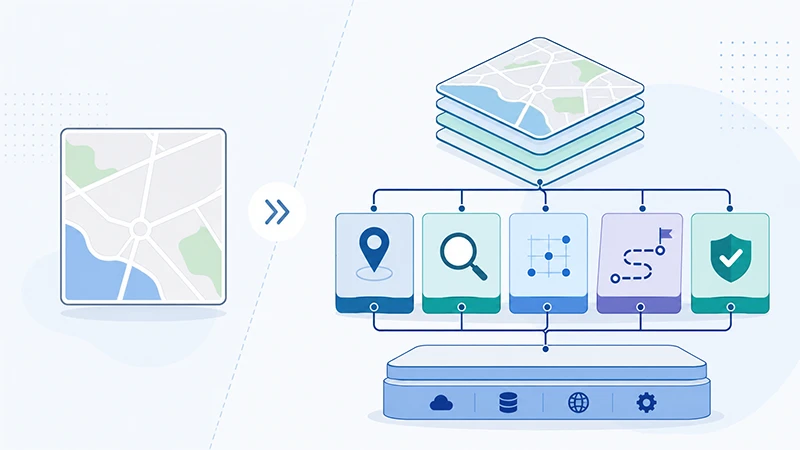
Compare that to what a managed location platform bundles: the map, the tiles, a maintained global dataset, an address-autocomplete and geocoding API, search, distance and routing services, an SLA, and a support team. MapLibre gives you exactly one layer of that stack - the rendering - and expects you to source the rest. That is not a criticism; it is the design. But it means "replace MapLibre" and "replace a platform" are different sentences, and confusing them is how teams end up with the wrong tool.
Why Teams Go Looking for a MapLibre Alternative
The pattern is consistent. A team adopts MapLibre because it is free and open-source, ships a first version quickly using a free tile source, and then hits the parts of the stack the library never covered. The reasons for evaluating an alternative cluster into four recurring buckets.
The tile-and-data problem. A rendering library needs vector tiles to render, and those tiles have to come from somewhere. Your options are to pull them from a managed tile provider (which reintroduces a vendor and a bill) or to self-host: run a tile server, ingest and process OpenStreetMap data, keep it updated on a schedule, host and version your style files, put a CDN in front of it, and monitor the whole thing. Free map data is genuinely free. Operating a production tile pipeline on top of it is not.
The missing services problem. The moment your product needs to turn a typed address into coordinates, autocomplete a search field, find the nearest store, or sort results by drive time, you are outside MapLibre's scope entirely. You now need a separate geocoding provider, a separate search layer, and possibly a routing engine - each with its own integration, its own pricing, and its own data-quality profile. The map was the easy 20 percent.
The operational-cost problem. This is the one that surprises finance. The MapLibre license costs nothing, but the total cost of ownership of a self-hosted stack is engineering time: the initial build, the on-call rotation, the data-refresh jobs, the scaling work when traffic spikes, and the opportunity cost of senior engineers maintaining map infrastructure instead of your core product. There is no SLA except the one your own team provides, and no support line except your own incident channel. For a small team, "free" can quietly become the most expensive line item you have.
The accountability problem. Open-source has no throat to choke. When rendering breaks on a specific Android device, or a data region is stale, or a security question comes from your customer's procurement team, there is no vendor obligated to answer. For consumer side-projects that is fine. For a revenue-carrying checkout or store finder, the absence of a contract and a support commitment is often what pushes a team to evaluate a managed option.
None of this makes MapLibre the wrong choice. It makes it a choice with a specific bill attached - one paid in engineering hours rather than invoices.
The Two Families of MapLibre Alternatives
Because MapLibre is a library and not a platform, "alternatives" split into two genuinely different strategies. Getting this split right is most of the decision.
Family 1 - keep MapLibre, buy the tiles. If your only real gap is the tile-and-data pipeline, you do not have to abandon MapLibre at all. Pairing MapLibre GL with a managed tile provider gives you open-source rendering with none of the tile-hosting operations. This is what people usually mean by "MapLibre managed hosting": someone else runs the tile server, maintains the data, and serves styled tiles over a CDN, while your front-end code stays on the open-source library. It is the lowest-friction path and preserves the vendor-neutrality that drew you to MapLibre in the first place.
Family 2 - replace the do-it-yourself stack with a managed platform. If your gaps go beyond tiles - you need geocoding, address autocomplete, store search, routing, an SLA, and support behind one contract - then the honest move is a managed location platform. You give up some of the pure open-source control, but you stop assembling and operating four or five separate services. For a product where location drives conversion or revenue, that trade is often worth it.
The rest of this guide walks the concrete options in each family.
MapLibre Alternatives Compared
MapTiler - managed tiles for a MapLibre front end
MapTiler is the most direct answer to "I want to keep MapLibre but not run tile infrastructure." It provides production-ready, styled vector tiles built on OpenStreetMap data, and its SDK is itself based on MapLibre - so moving from a raw MapLibre setup (or from Mapbox GL JS) can be a few lines of initialization code rather than a rewrite. It imposes no lock-in on the rendering side, since you are still on the open-source library, and it offers a no-code styling tool and a free tier for smaller projects. If your gap is purely tiles and hosting, this is usually the shortest path.
Stadia Maps - privacy-conscious managed tiles and geo APIs
Stadia Maps is another managed provider designed to slot under a MapLibre front end, serving vector tiles and adding geocoding and routing APIs on top of open data. It positions itself around predictable pricing and a privacy-conscious data posture, and like MapTiler it is a natural fit when you want to stay on open-source rendering while outsourcing the operational layer. It fills a bit more of the stack than tiles alone, which makes it a reasonable middle step between Family 1 and Family 2.
Mapbox - the commercial origin
Mapbox is where the rendering engine came from, and it remains a strong platform when the map itself is the product. Mapbox Studio is still the most capable no-code cartography tool available, and for data-visualization and media products that need a distinctive, brand-defining map, it is hard to beat. Two caveats matter for a MapLibre evaluator. First, its free tier requires a credit card, and its APIs bill independently across map loads, geocoding, and search, so combined cost at scale needs modeling. Second, its roadmap now centers on automotive - the ADAS SDK, the Dash product, and the Toyota RAV4 partnership - rather than commerce use cases like checkout or store finder. Choosing Mapbox means re-entering a proprietary rendering ecosystem, which is the exact thing the MapLibre fork exists to avoid.
Google Maps Platform - coverage and familiarity
Google Maps Platform offers the deepest global POI dataset and the map tiles most consumers already recognize. It is priced per map load (per load, not per tile) and now uses tiered plans rather than the older flat free credit, so the unit economics need checking against your volume. For a team leaving MapLibre specifically to stop assembling geocoding and search themselves, Google Maps Platform does bundle those services - but it also routes API requests through US infrastructure, which is a data-governance question for European teams, and its terms restrict caching and downstream use of geocoding results. It is a full platform, but not a neutral one. For a deeper look at that trade-off, see our full guide to Google Maps Platform alternatives.
Woosmap - a managed vector-map platform built for commerce
Woosmap sits in Family 2: it is a managed location platform whose Map JS API renders vector-based, 3D, fully customizable maps, and it ships the rest of the stack MapLibre leaves out - Localities autocomplete and geocoding, distance and isochrone routing, a store-locator widget, and mobile SDKs - behind one API and one contract. Two things distinguish it for the audience leaving a do-it-yourself MapLibre stack. Its infrastructure is European-hosted, which removes the US data-transfer question that comes with several US-based platforms, and its data is curated for retail and commerce use cases rather than consumer navigation. Enterprise plans include a dedicated Customer Success Manager, health checks, workshops, and budget monitoring, and there is a 99.9% SLA on the Enterprise tier - the accountability layer a self-hosted stack does not have. The positioning is control and conversion, not "a cheaper map": you are buying back the engineering time that self-hosting tiles, data, and geo services would otherwise consume. Pricing is per 1,000 requests, with free usage tiers across most APIs (for example, 10,000 map loads per month before paid tiers begin).
HERE, TomTom, and Azure Maps - other full platforms
Three more managed platforms round out Family 2 for specific needs. HERE Technologies has the deepest truck and fleet routing (weight, width, hazmat, tolls) and EV charge-aware routing, though it has a pattern of regular price increases and a more complex, multi-edition onboarding - see our HERE Technologies alternatives breakdown. TomTom offers a developer-friendly free tier with no credit card required and industry-leading real-time traffic; our TomTom alternatives guide covers where it fits. Azure Maps, built on TomTom and HERE data, is the natural pick if you are already standardized on Microsoft - though note its Gen1 pricing is retiring in September 2026, so evaluate against Gen2.
MapLibre Alternatives at a Glance
The table below compares the two families against a raw self-hosted MapLibre baseline. The dimensions that matter for this decision are not rendering quality (they are all capable maps) but how much of the stack and operations each option removes from your plate.
Option
What it is
Tiles & data included
Geocoding / search / routing
SLA & support
EU-hosted option
Best for
MapLibre (self-hosted)
Open-source rendering library
No - you host tiles + OSM data
No - integrate separately
None - self-operated
Your choice (you host)
Teams with infra capacity and a pure display need
MapLibre + MapTiler / Stadia
Open-source rendering + managed tiles
Yes (managed tiles)
Partial (Stadia adds some)
Provider SLA on tiles
Varies by provider
Keeping open rendering, dropping tile ops
Mapbox
Proprietary rendering platform
Yes
Yes
Yes (paid tiers)
No (US-hosted)
Brand-defining cartography, automotive
Google Maps Platform
Full platform
Yes
Yes
Yes
No (US infrastructure)
Global POI depth, consumer familiarity
Woosmap
Managed platform (commerce-focused)
Yes
Yes (autocomplete, geocode, distance, store search)
Yes (99.9% Enterprise)
Yes (EU-hosted)
Commerce/retail teams wanting the full stack in one contract
HERE / TomTom / Azure
Full platforms
Yes
Yes
Yes
Varies
Fleet/logistics (HERE), traffic (TomTom), Microsoft stack (Azure)
Competitor tiers and figures change - always confirm current pricing on each provider's official pricing page before modeling costs.
How to Choose: A Decision Framework
Map your situation to a row. The recommendation follows from how much of the stack you want to own versus buy, not from which map looks best.
Your situation
Recommended path
Why
Pure map display, in-house infra capacity, cost-sensitive
MapLibre + self-hosted tiles
Lowest license cost; you already have the operations muscle
Want open-source rendering, but no appetite to run tile servers
MapLibre + MapTiler or Stadia (managed tiles)
Keeps vendor-neutral rendering; removes the tile-ops burden
Need geocoding, address autocomplete, store search, routing - not just a map
Managed platform (Woosmap for EU/commerce)
One API and one contract instead of assembling four services
Automotive, in-car navigation, or turn-by-turn is the product
Mapbox or HERE
Roadmaps and routing depth built for vehicles
Standardized on Microsoft or need deep global consumer POIs
Azure Maps or Google Maps Platform
Ecosystem fit and dataset depth
Data residency / EU governance is a hard requirement
EU-hosted managed platform
Removes the US data-transfer question a self-hosted or US platform leaves open
The architecture test that cuts through it: write down every location capability your product needs in the next twelve months - display, address entry, search, distance, routing, offline. If the list is one item (display), MapLibre plus managed tiles is very likely your answer. If it is four or more, you are buying a platform whether you build it or purchase it, and the only question is who operates it.
When MapLibre Is Still the Right Choice
It is worth being clear, because the honest answer sells better than the pitch. If your product genuinely needs only a rendered map, your team has real infrastructure capacity, and you value complete control and zero licensing risk above operational convenience, MapLibre - self-hosted or paired with a managed tile provider - is an excellent, durable choice. The open-source governance means no vendor can change your terms, and the rendering quality is on par with the commercial engine it forked from. Many production applications run on exactly this setup and should keep running on it. A managed platform earns its cost only when the stack you would otherwise assemble and operate is larger than the map itself. For a developer-oriented view of the same trade-off from the Mapbox side, our Mapbox versus Google Maps comparison walks the rendering and pricing detail.
Frequently Asked Questions
MapLibre is an open-source library for rendering interactive vector maps, forked from Mapbox GL JS in late 2020 after Mapbox moved to a proprietary license. It is free to use under a permissive open-source license, with web (MapLibre GL JS) and native (MapLibre Native) implementations. "Free," though, refers to the library itself. Running it in production still requires vector tiles, map data, and any geocoding or search services - which you either self-host or buy. The rendering engine costs nothing; the surrounding stack has a real cost in either engineering time or provider fees.
MapLibre GL JS is the open-source fork of Mapbox GL JS, created after Mapbox relicensed version 2 of its library as proprietary. Functionally the rendering is very close, since MapLibre began as the same codebase. The difference is governance and scope. MapLibre is community-governed, free, and library-only. Mapbox is a commercial platform that bundles tiles, data, geocoding, search, and support behind paid tiers, includes the Mapbox Studio design tool, and requires a credit card for its free tier. Choosing MapLibre keeps you vendor-neutral; choosing Mapbox buys you the full managed stack.
No. This is the most common misunderstanding. MapLibre renders vector tiles that you supply - it does not generate tiles or maintain any underlying map dataset. You provide tiles either by self-hosting them (processing OpenStreetMap data and running a tile server) or by subscribing to a managed tile provider such as MapTiler or Stadia Maps. Think of MapLibre as the display engine and the tiles-plus-data as the fuel it needs to show anything.
"MapLibre managed hosting" usually means pairing the open-source MapLibre front-end library with a third-party service that hosts and serves the tiles and map data for you - so you get open-source rendering without operating tile-server infrastructure yourself. Providers like MapTiler and Stadia Maps offer exactly this: styled vector tiles over a CDN, maintained on their side, consumed by your MapLibre code. It is the middle path between fully self-hosting and adopting a full proprietary platform.
Only partially. MapLibre can replace the map-display portion of Google Maps, but Google Maps Platform is a full platform that also provides geocoding, places data, search, and routing, whereas MapLibre provides none of those. To match Google Maps' capabilities with MapLibre, you would assemble several additional services around it. If your goal is to leave Google specifically, compare full managed platforms rather than a rendering library - our Google Maps Platform alternatives guide covers the options in depth.
Choose a managed platform when your product needs more than a rendered map - specifically geocoding, address autocomplete, store or product search, distance and routing, an SLA, and support - and when the engineering time to build and operate those services yourself would exceed the cost of buying them. Teams where location drives revenue (checkout conversion, store discovery, marketplace search) usually reach this point quickly. Teams that need only display, and have the infrastructure capacity to run tiles, are better served staying on MapLibre.
Choosing a MapLibre Alternative Is a Stack Decision
The label "MapLibre alternative" is misleading, because MapLibre is not competing for the same job as the platforms people compare it to. It renders maps, brilliantly and freely. Everything else - tiles, data, geocoding, search, routing, uptime, support - is either work you take on or a product you buy. Decide how much of that stack you want to own before you shortlist any tool, and the choice mostly makes itself.
If you want to stay on open-source rendering, pair MapLibre with a managed tile provider and you are done. If your product needs the full location stack behind one contract, evaluate a managed platform against your actual capabilities and, for European teams, your data-residency requirements. To see how a full managed stack is priced against a build-it-yourself approach, see Woosmap pricing and model it against the engineering hours your current setup consumes.
This analysis was written by Jean-Thomas Rouzin, CEO of Woosmap. Jean-Thomas leads a European location intelligence platform serving 220+ enterprise clients across retail, logistics, and travel, processing 28B+ location context calls per year with a 99.9% SLA on the Enterprise plan.