📅 Free webinar · 14 October, 11-11.30am BST (UK time)Will AI recommend your stores? Three moments that decide a saleSave your seat
Is Google Maps API Free in 2026? The Honest Answer
Jean-Thomas Rouzin - Reading time : 12 min
Table of contents
Google Maps API is not free, but parts of it are. Each Maps Platform product carries a small monthly free tier - usually the first 10,000 requests - and a paid rate above it. The universal $200 monthly credit that once covered light use was retired in March 2025. For a hobby project Google Maps API can still cost nothing. For a real business it has a real bill.
What "free" used to mean - and why that answer is out of date
For most of the last decade, the standard answer to "is Google Maps API free" was "yes, up to a point - Google gives every account $200 of credit every month, and most light workloads stay under it." That answer survived in forum posts, AI chatbot replies, and competitor comparison pages well into 2026. It is no longer correct.
Google retired the universal $200 monthly credit in March 2025. The replacement model is a set of per-SKU monthly free tiers - each product (Maps, Geocoding, Places, Routes, and so on) carries its own free allowance, and the allowances no longer pool. The practical consequence is that a workload that used to run "for free" under the old credit can now produce a real invoice the moment it crosses a single product's allowance, even if every other product is under-used.
This article is for a decision-maker trying to answer the original question honestly: where Google Maps API is genuinely free in 2026, where the bill starts, and how to read the rate card without getting trapped by the parts that everyone misses.
What is actually free in Google Maps API today
There are three categories of "free" worth separating before looking at rates. They behave differently and they trip up different kinds of teams.
The per-SKU monthly free tier
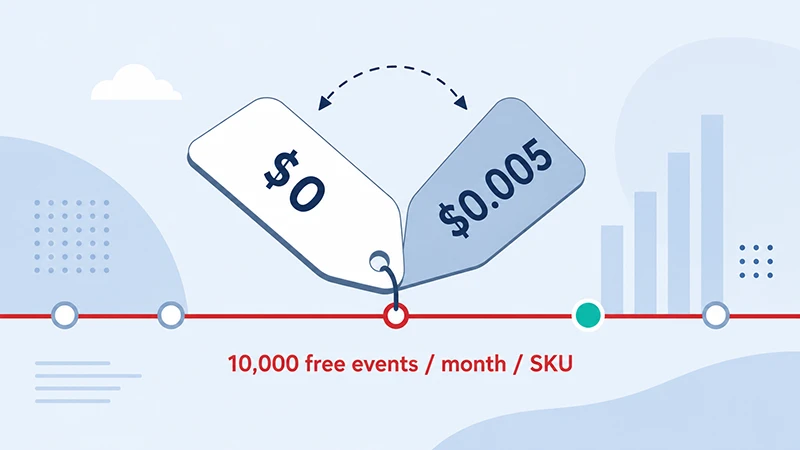
Each Google Maps Platform SKU carries a monthly free event count. Above that count the SKU bills at the published rate for the tier you have entered. The exact number varies by SKU. Looking at the three lines that matter most for retail and marketplace workloads:
Geocoding API: 10,000 free geocode requests per month.
Places API - Autocomplete Session Usage: free at every volume tier when the session is closed by a Pro or Enterprise Place Details call.
These free tiers reset every calendar month and do not roll over. They are not transferable across SKUs. Using Maps JavaScript heavily does not reduce the Geocoding allowance, and vice versa.
"Free" in the sense of "bundled into another call"
The Places API has a structural form of free that is easy to miss. When a Place Details (New) request closes a session at the Pro or Enterprise tier, every Autocomplete request inside that session is billed at the SKU "Autocomplete Session Usage" at $0. The Place Details call is the paid line item. The keystrokes are free riders. This is the case that makes "Google charges per keystroke" wrong as a default claim, and it is also the case where most third-party calculators over-estimate the bill.
Two rules govern this kind of free:
The session has to be closed. A session that is abandoned reverts every Autocomplete request to the paid per-request SKU.
The closing call has to be Pro or Enterprise. If it closes with Essentials, only the first 12 Autocomplete calls in the session move to the free Session Usage SKU - the early ones bill individually.
The detailed mechanics of this case live in our Google Places API pricing breakdown for readers who need to model an address-capture or store-locator workload.
Free under "trial" or "evaluation" frames
The third category is the temporary free that comes with starting a Google Cloud account: a $300 cloud trial credit on first sign-up, valid for 90 days and not specific to Maps. This credit consumes against any billable Google Cloud usage, including Maps Platform, but it is a one-time onboarding incentive, not an ongoing free tier. It is also why a developer testing Google Maps for the first week often reports "it is free" - in their account, for those 90 days, it was. By month four it is not.
The price list above the free tier (June 2026, per 1,000 requests)
Once the monthly free events are consumed, the bill follows a tiered rate card. Numbers below are the published Google Maps Platform rates at the 10,000-100,000 monthly volume band, in USD, current at the time of writing.
Higher volumes step into 100K-500K, 500K-1M, 1M-5M, and 5M+ bands, with per-1K rates that drop at each threshold. The free tier is always applied at the bottom of the calculation: the first 10,000 events on each SKU are free, the rest is paid at the rate of the band the account has entered.
Two rules from the rate card that matter when you build a budget:
Free tiers are per SKU and do not pool. Five SKUs that each have a 10,000-event free tier do not give you 50,000 free events across products. They give you 10,000 free events on each of five products. Workloads that lean heavily on one SKU exhaust that SKU's free tier and start paying while the others remain unused.
Tier breakpoints apply to the whole month's volume, not to incremental usage. Crossing 100,000 events on a SKU does not just price the request that crossed the line - it changes the per-1K rate that applies to the next batch. Most calculators that take a single "per 1K" rate as their input under-estimate the bill at month-end because they assume one tier for the whole month.
When Google Maps API is genuinely free for your project
There are workloads where Google Maps Platform really costs $0 and the answer to the question is yes. They share three properties.
The monthly volume on every used SKU stays below the free tier. A static restaurant website with a single embedded map that loads 8,000 times a month is genuinely free. A small directory site that runs 6,000 geocode requests on stored addresses each month is genuinely free. The free tier is real and it covers a non-trivial amount of light use.
No high-priced field categories are needed. A workload that resolves addresses without needing the Place Details Pro response - just place IDs and formatted addresses - keeps Place Details usage in the Essentials category. Essentials is the cheaper line item and the one most likely to stay inside the free tier.
Usage is steady, not bursty. The free tier is calculated by month, so a burst that pushes a normally quiet SKU over 10,000 events in a single bad week triggers paid pricing for the month even if usage falls back. Workloads where traffic spikes - a Black Friday sale, a press event, a viral moment - rarely stay in the free zone consistently.
Examples of workloads that typically remain free under the 2026 model:
A single store locator with under 8,000 monthly map loads and no in-checkout autocomplete.
A static lookup page (postcode finder, where-am-I tool) that uses one Geocoding SKU and stays under the monthly allowance.
A demo or evaluation environment used by a small engineering team during development.
When it stops being free, and where the bill grows fastest
The same model produces a real bill the moment one of three things happens. These are the cases worth modelling before you decide whether the answer "yes, it is free" applies to your account.
You add a high-volume product to the mix. The Dynamic Maps SKU at $7 per 1,000 is the line item that hits e-commerce sites first. A homepage with an embedded map that loads on every visit will burn through 10,000 free loads in days at modest traffic. Once paid, Dynamic Maps is the most expensive of the common workloads at this tier.
You move from Essentials to Pro on Place Details. A switch from Essentials to Pro - because the product needs opening hours, contact info, or detailed address components - upgrades every closing call in that session bracket to Pro pricing. Pro is $17 per 1,000 versus Essentials at $5 per 1,000. At 100,000 monthly sessions that swap moves the line item from $475 (95,000 paid Essentials calls) to $1,615 (95,000 paid Pro calls). Same number of users, different field profile, three-and-a-half times the bill.
You scale past a tier breakpoint. At 100,000 monthly events on a SKU the per-1K rate drops, but the free tier is now a much smaller share of the bill. The structural effect is that the per-customer cost of using Google Maps API rises with growth and then partially flattens at scale - not linearly, but in jumps. A workload that costs $0 at 9,000 monthly map loads can cost $4,200 at 600,000 monthly map loads. That is not a 67x jump - it is roughly what a steady scale curve looks like above the free tier.
A useful way to read the bill is to look at which single SKU dominates the invoice. For checkout and address-capture flows, it is almost always Place Details Pro. For store-locator pages and homepages with embedded maps, it is Dynamic Maps. For matching and routing flows on marketplace platforms, it is Compute Route Matrix. The SKU that dominates is also the SKU where a small architectural choice - cache versus call, Essentials versus Pro, static versus dynamic - has the biggest impact on the monthly invoice.
How other location API providers handle the same question
The honest answer to "is location API free" is not unique to Google. Every commercial provider in this market runs some version of the same model: a free monthly allowance on each product, paid rates above. The differences are in the size of the free tier, whether a credit card is required to start, and whether the per-request rate hides a session-billing twist.
A short and factual scan of how the main alternatives handle the free question, current at the time of writing:
Mapbox publishes free monthly tiers per product (for example, 50,000 free web map loads per month) and requires a credit card to activate the account. Above the free tier, rates are per SKU. Some Mapbox product terms - notably the Navigation SDK and Dash App - carry usage clauses around input data that warrant a legal review before adopting at scale.
TomTom also publishes per-product free tiers and does not require a credit card to start. Free allowances are generous for tile-based usage. Above free, rates are per SKU with a pay-as-you-grow band model.
HERE Technologies offers a free Freemium tier and otherwise follows a quota-based pricing structure. HERE has a documented pattern of regular price increases at renewal - the current published rates are not necessarily the rates that apply on a multi-year commitment.
Azure Maps offers a smaller free tier (around 5,000 base map transactions per month) and counts Autocomplete as "every 10 requests = 1 transaction." Gen1 pricing retires in September 2026 - Gen2 is the future, and accounts on Gen1 need a migration plan.
Woosmap publishes free monthly tiers across its APIs (10,000 free events per month on most SKUs, 5,000 on the Localities Details SKU) at rates the company prices at roughly 40-50% of the Google Pro tier on equivalent usage. The Localities Autocomplete SKU is free at every monthly volume tier with no session-token requirement.
This list is not exhaustive. The point is that the question "is it free" lives in a market where every provider answers "free up to here, paid above here," and the meaningful decision is not whether to find a vendor that is structurally free - none of them are - but to find the vendor whose free-tier shape and above-free rate best fits the workload you actually have.
A decision framework for the "should I stay on free Google" question
If the workload genuinely lives inside the Google Maps Platform free tier today, the right answer is to stay there. Switching providers carries a switching cost that does not earn back at $0 monthly billing.
The question becomes interesting in three cases.
Case 1 - the bill exists but is small (under $500 / month). At this scale, the bill is below the integration cost of a switch. Optimization inside Google Maps Platform - caching geocode results, moving from Pro to Essentials where field requirements allow, switching from Dynamic Maps to Static Maps for SEO landing pages - usually returns more than a migration would.
Case 2 - the bill is mid-scale ($500 - $5,000 / month). This is the band where the architectural shape of the workload starts to matter more than the rate. A workload that is 80% Place Details Pro is sensitive to vendor choice. A workload that is 80% Dynamic Maps is sensitive to whether your SEO requires server-side rendering, in which case Maps Static (or a vector tile alternative) collapses the bill more than vendor choice would. This band is where a structured comparison - same workload, real numbers, multiple vendors - earns its cost.
Case 3 - the bill is significant ($5,000 / month and up). At this scale the question is no longer "is it free" but "is it the right vendor at this scale." Total cost of ownership at high volume includes the rate card, the data-handling terms in the contract (who owns the search inputs of your end users, how long they are retained, what they can be used for), and the contractual SLA. Each of these can be more impactful than the headline rate. The published HERE pattern of regular price increases and the structural data-ownership questions around Google's self-preferencing case at the EU are examples of cost vectors that do not appear on a rate card.
The decision framework matters because the most common mistake at this stage is to compare published per-1K rates without normalizing them against the same workload. A 41% headline rate gap can collapse to a 10% effective gap once you account for free tiers, session billing, and field-tier mixing. It can also widen, in the other direction, if the published comparison rate is the wrong SKU.
Frequently Asked Questions
Yes for very light personal use. A single embedded map on a personal site with under 10,000 monthly loads, no Autocomplete-and-Place-Details flow, and no Routes calls will run inside the free tier and produce no invoice. Beyond those volumes, the per-SKU rates apply even to personal accounts. A Google Cloud billing account is still required to activate the API key, even when usage stays free.
Yes. The universal Maps Platform credit that pooled across all SKUs was retired in March 2025 and replaced by per-SKU monthly free tiers. The current free-tier model lives on the Google Maps Platform pricing page. A separate $300 Google Cloud trial credit still exists for new Cloud accounts - that is an onboarding incentive, not a Maps-specific free tier.
That depends on which products run the sessions. A retail checkout flow at 100,000 monthly Autocomplete sessions terminating with Place Details Pro produces a Places API bill of roughly $1,615 above the free tier ($17 per 1,000 on the 95,000 paid sessions). A store-locator flow at 100,000 monthly Dynamic Map loads adds roughly $665 ($7 per 1,000 on the 95,000 paid loads). The total scales with the number of distinct SKUs the workload hits, not with the number of users.
There is no commercial alternative that is structurally free at scale. Every commercial location API runs on the same "free tier then paid" model. Open-source alternatives (Leaflet for map display, Nominatim for geocoding) exist and carry no licensing fee, but they come with the operational cost of self-hosting, no SLA, and variable data quality - which is its own bill, paid in engineering time rather than dollars.
Probably. The 2025 retirement of the pooled credit was a meaningful shift, and the SKU structure has been adjusted multiple times in the last decade. A budget that assumes today's free tiers and rates will hold for a multi-year project carries some risk. The published rate card is the source of truth at any given moment - rates reproduced in third-party articles drift quickly.
So is Google Maps API free, or not?
The accurate one-line answer in 2026 is: Google Maps API is free for the first 10,000 events per month on most SKUs, and paid above that. There is no longer a universal $200 monthly credit. For a hobby project the free tier still covers a meaningful workload. For a real business with checkout autocomplete, store locators, or routing at scale, the free tier covers a few days at the start of the month and the rest is invoiced.
The question worth asking, once that is clear, is not whether Google Maps API is free - it is whether the rate card above the free tier is the right one for your workload. That is a question for Woosmap's pricing page and the equivalent calculators on every other vendor's site. The answer changes more with the shape of the workload than with the vendor.
If you would like to dig into the math for a specific workload, Woosmap publishes its complete rate card alongside the SKU-by-SKU detail you would need to model a switch honestly - including the cases where staying on Google Maps Platform is the right answer.
This analysis was written byJean-Thomas Rouzin, CEO of Woosmap. Jean-Thomas leads a European location intelligence platform serving 220+ enterprise clients across retail, logistics, and travel, processing 28B+ location context calls per year with a 99.9% SLA on the Enterprise plan.