📅 Free webinar · 14 October, 11-11.30am BST (UK time)Will AI recommend your stores? Three moments that decide a saleSave your seat
Google Places API Pricing in 2026: What a Session Actually Costs
Jean-Thomas Rouzin - Reading time : 12 min
Table of contents
Google Places API bills per session, not per keystroke. A typical checkout session that ends with a Place Details Pro request costs $17 per 1,000 sessions above the free tier - the Autocomplete keystrokes are bundled in for free. The bill changes shape when sessions are abandoned, when Place Details Essentials is used instead of Pro, or when monthly volume crosses tier breakpoints. Most published cost estimates miss at least one of these three factors.
Why the per-keystroke story is the wrong place to start
A common framing in vendor pitches and old blog posts is that Google charges per Autocomplete keystroke and that a typical user types eight characters, so a session costs eight times the per-request rate. That framing was accurate in 2018. It has not been accurate since Google introduced session-based pricing for the Places API and made the Autocomplete portion of a properly terminated session free.
The model that matters in 2026 has three knobs - which Place Details tier you terminate with, whether your sessions are completed or abandoned, and what monthly volume tier your account falls into. Get those three right and the bill is predictable. Get them wrong and a budget can be off by 10x for the same number of users typing the same number of characters.
This article walks a decision-maker through what Google Places actually bills today, where the bill grows at scale, and what the published rates do not tell a procurement team about the total cost of running the API in production.
How Google bills a Places session today
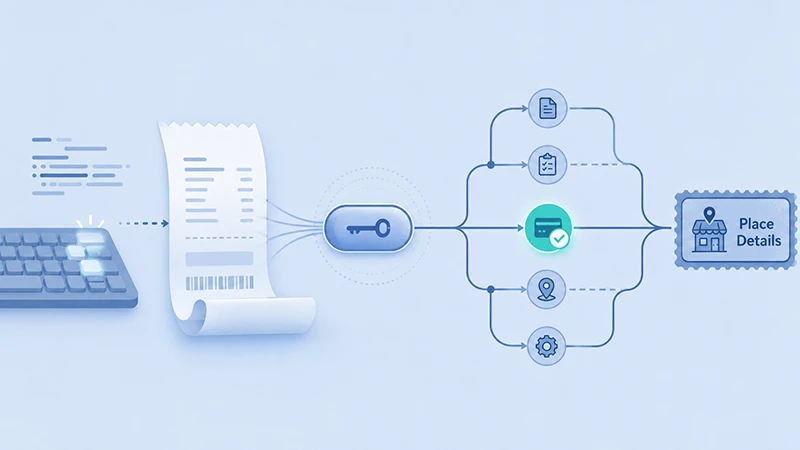
A Google Places session is a unit of work that ties an Autocomplete query stream to a single resolution event. The cycle looks like this:
The client generates a session token (a UUID is the recommended pattern).
The token is sent on every Autocomplete (New) request as the user types.
The session is closed by exactly one Place Details (New) request - or by an Address Validation request - sent with the same token.
The token is then invalidated. Any new search needs a new token.
The pricing rule that governs the session is straightforward: the tier of the closing Place Details request determines how the preceding Autocomplete calls are billed. There are three cases worth modelling.
Closing with Place Details Pro or Enterprise
When the terminating call uses fields that fall into the Pro or Enterprise field categories, every Autocomplete request in the session is billed at the SKU "Autocomplete Session Usage" - which is $0 at every volume tier. The only paid line item is the single closing Place Details request.
This is the case that matters for retail checkout and address-capture flows that need the full place record. A typical eight-keystroke session costs the same as a one-keystroke session: one Place Details call at $17 per 1,000 (Pro tier 10K-100K) or $20 per 1,000 (Enterprise tier 10K-100K).
Closing with Place Details Essentials
When the closing call only requests Essentials-tier fields (place ID, formatted address, coordinates), the Autocomplete billing changes. The first 12 Autocomplete requests in the session are billed individually at SKU "Autocomplete Requests" - $2.83 per 1,000 at the 10K-100K tier. The 13th request onwards is free under SKU "Autocomplete Session Usage." The terminating Place Details Essentials call costs $5 per 1,000.
For a session where a user types eight characters and lands on a suggestion, the cost is 8 × $0.00283 + $0.005 = $0.0276, or $27.60 per 1,000 sessions. That is higher than the equivalent Pro session ($17 per 1,000) because the Autocomplete portion is no longer absorbed by Session Usage.
Abandoned sessions
A session is abandoned when the user starts typing but does not select a suggestion - they close the tab, switch tabs, or back out of the field. With no Place Details call to terminate the session, every Autocomplete request reverts to the per-request SKU at $2.83 per 1,000.
An abandoned session of eight keystrokes costs 8 × $0.00283 = $0.0226, or $22.60 per 1,000 abandoned sessions. The structural consequence is that an abandoned session can cost more than a completed one - a counter-intuitive result that most internal cost models miss because they assume "user didn't convert" means "we didn't pay."
The actual price list (June 2026, per 1,000 requests)
The numbers below are the published Google Maps Platform rates at the 10K-100K monthly volume tier, in USD, as of June 2026. Higher volumes step down through 100K-500K, 500K-1M, 1M-5M, and 5M+ tiers - the structure is the same, the per-1K prices drop. The free tier varies by SKU.
Google Places SKU
Free tier (monthly)
Above free, per 1,000 (10K-100K)
What it does
Autocomplete Session Usage
5,000
$0 (free at all tiers)
Bundles Autocomplete calls in a Pro/Enterprise session
Autocomplete Requests
5,000
$2.83
Per-request Autocomplete (non-session, abandoned, or Essentials > 12 calls)
Place Details Essentials (IDs + minimum fields)
10,000
$5.00
Place ID, formatted address, coordinates
Place Details Pro
5,000
$17.00
Adds opening hours, contact info, types, plus Atmosphere when requested
The Place Details tier is set by the fields you request, not by a billing switch. Asking for any Pro-tier field upgrades the entire response to Pro pricing. Asking for any Enterprise-tier field upgrades it to Enterprise. There is no partial billing.
The Autocomplete session is closed by exactly one terminating call. Reusing a session token across multiple Place Details calls invalidates the session and reverts all Autocomplete calls to per-request billing.
The bill at three scales: completed sessions only
Below is what Google Places costs in three workload sizes, assuming every session terminates with a Place Details Pro request (the most common pattern for retail address capture and store-locator address resolution). The Woosmap column is included for context because the Pricing Sanity Check ratio is the cleanest way to read whether a Places bill is on or off the market average.
Source : Google figures from the Places API usage and billing page ; Woosmap figures from the published Woosmap pricing page. Volume discounts apply automatically as monthly volume crosses tier thresholds - the calculation above shows the blended bill, not a single-tier rate.
The headline observation : for any monthly volume above 10,000 sessions, Place Details Pro is the dominant line item. Autocomplete is essentially free in the Pro/Enterprise case. That means the lever a finance team has to pull is the field profile of the terminating call, not the keystroke count.
What the published rates do not include
Three cost vectors live outside the per-1K rate card and account for most of the gap between "what the calculator says" and "what the bill says."
1. Abandonment
If 30% of users start an Autocomplete session and then close the tab without selecting a suggestion, those sessions cost $2.83 per 1,000 per keystroke. A retail funnel with 100,000 monthly checkout starts and a 30% abandonment rate at the address field, where the average user types eight characters before abandoning, is paying for an extra 30,000 × 8 = 240,000 Autocomplete requests above the per-SKU free tier.
That is roughly 235,000 × $2.83 / 1,000 ≈ $665 per month in abandonment cost. Not catastrophic, but it is real money that does not show up in a completed-session cost model.
2. The Place Details tier creep
Adding a single field that falls into the Pro tier - opening hours, business status, types - upgrades the entire Place Details response from $5 per 1,000 to $17 per 1,000. The same is true for the Enterprise jump : adding reviews or photos jumps the bill to $20 per 1,000.
Teams that started on Essentials for a postcode-resolution use case and later added "show the business name in the dropdown" do not always realize that the new dropdown costs 3.4x the old one. This is invisible until the next billing cycle.
3. Atmosphere and editorial fields
The Place Details Enterprise + Atmosphere SKU exists for use cases that need reviews, photos, ratings, and pricing fields. It runs around $25 per 1,000 above the free tier at 10K-100K volume. For most retail and marketplace use cases - where the goal is to resolve an address or rank stores by proximity - Atmosphere data is not needed. A field-by-field audit of the Place Details requests can pull a bill back from Enterprise + Atmosphere to Pro and cut the line item by 20-25%.
The rule is the same in all three cases : the cost model is set at the field-selection layer, not at the API-call layer.
How to read a Places bill without misreading it
A Places bill that comes in higher than expected almost always traces back to one of four root causes. The diagnostic order matters - check them in this sequence.
First, audit the field profile of Place Details calls. Are any Pro-tier fields being requested when only Essentials fields are used downstream? Are any Enterprise fields being requested for a use case that does not display reviews or photos? Pull the production payloads and map each field to its tier.
Second, audit session termination. Are all sessions being terminated with a Place Details or Address Validation call? Or are sessions being abandoned in code paths that should resolve to a place but do not? Abandonment can come from bugs as easily as from user behaviour.
Third, audit session token reuse. Tokens that are reused across multiple Place Details calls invalidate the session and revert Autocomplete to per-request pricing. This is one of the most common silent cost drivers - it shows up as a high Autocomplete Requests line item that "should not be there."
Fourth, audit the volume-tier breakpoints. A team that crossed 100,000 monthly sessions for the first time will see a lower marginal rate on the 100K-500K block. A team that crossed 500K will see another step down. These thresholds reset at the start of each calendar month and affect the bill non-linearly.
If those four passes do not explain the variance, the answer is usually outside the Places API entirely - a billing change elsewhere on the Maps Platform account, a deprecated SKU that has been migrated to a new line item, or a usage pattern in a non-checkout surface (such as backend POI enrichment) that is hitting Place Details in a tight loop.
When the Places API is the right answer - and when it is overkill
The Places API is the right tool when an application needs Google's full place graph - tens of millions of points of interest worldwide, business listings with hours and reviews, atmosphere data. For consumer products that surface "find a Starbucks near me" or "show me restaurants with outdoor seating," the Places dataset is a defensible default.
It is overkill, and structurally expensive, for use cases where:
The store catalog is owned by the customer and lives in their own database (most store locators, dealer locators, click-and-collect flows). Place Details should not be used to display store data - the customer's database is the source of truth and Distance Matrix + Map Load are the right SKUs.
The address resolution path is "user types an address, we resolve it to coordinates." The right tool is a Geocoding API, not Place Details. Geocoding API costs $5 per 1,000 (Google) or $2.04 per 1,000 (Woosmap Geocode) at 10K-100K - not $17 per 1,000.
The autocomplete needs to surface only addresses, not businesses or landmarks. Address-only autocomplete is a structurally different product and several providers price it at a free tier with no session token requirement at all.
A decision framework worth walking through before signing a Places contract:
If you need the full POI graph, Google is the default ; for retail-curated POIs, Woosmap is comparable at 40% of the cost
Place enrichment (reviews, hours, photos)
Place Details Enterprise + Atmosphere
Google is the default
No alternative provider offers the same depth of consumer review data
Address validation only
Address Validation API
Loqate, Woosmap UK addresses
Address validation is a separate market with cheaper specialists
A note on the alternatives picture
The structural reason commerce buyers look at Google Places alternatives is not that Google is technically inferior - it is that the pricing model and the dataset are optimized for consumer search use cases (Google's core business), not retail or marketplace commerce. Providers like Woosmap, Mapbox, and HERE publish direct per-1,000 pricing without session-token mechanics and tend to land between 40% and 60% of the equivalent Google Pro tier bill - the public Woosmap pricing maintains a ~41% ratio on the SKUs that map cleanly across providers.
The trade-off worth understanding is that Google's place graph is broader (consumer POIs, reviews, photos) while the alternatives' graphs are narrower and curated for commerce use cases (addresses, store-relevant POIs, no atmosphere data). For a checkout flow or a store locator, the narrower graph is usually the better fit. For a consumer-facing "find places near me" feature, the broader graph is.
If a team is in the middle of an evaluation, the most useful next step is to model the bill three ways - completed sessions only, completed + 30% abandonment, and completed with one Pro-tier field accidentally requested. The spread between those three numbers is the real procurement risk. If it is more than 2x, the cost model is exposed to a configuration drift that will surface as a billing surprise.
Two pages worth bookmarking : the Google Maps Platform pricing page for the canonical per-SKU figures, and Woosmap's pricing page for a side-by-side reference at the same volume tiers. The teams that get pricing right early do not eliminate the bill - they make it predictable, which is what a CFO actually wants from a location vendor.
Frequently Asked Questions
Google Places does not have a single per-request price - the bill depends on the SKU. Place Details Essentials is $5 per 1,000 requests at the 10K-100K monthly volume tier, Pro is $17 per 1,000, and Enterprise is $20 per 1,000. Autocomplete is $2.83 per 1,000 in per-request mode, but $0 inside a Pro or Enterprise session. The 10K-100K tier rates step down at higher monthly volumes.
No. Google retired the universal $200 monthly credit in March 2025. The free tier is now per-SKU - 10,000 free events per month for Essentials SKUs, 5,000 for Pro, and 1,000 for Enterprise. There is no pooled credit pool ; each SKU consumes its own free allotment independently.
A session is a sequence of Autocomplete calls terminated by exactly one Place Details or Address Validation call, all linked by a single session token. When the session terminates with a Pro or Enterprise Place Details, every Autocomplete call in the session is free. When it terminates with Essentials, the first 12 Autocomplete calls are billed at $2.83 per 1,000 and the rest are free. When the session is abandoned, all Autocomplete calls revert to per-request billing.
Yes. Adding any field that belongs to a higher tier upgrades the entire Place Details response to that tier's price. Adding a single Pro-tier field to an Essentials request makes the request a Pro request. Teams that started on Essentials for postcode lookups and later added business name or opening hours often pay 3.4x more without realizing it.
For functionally equivalent calls at the 10K-100K volume tier, Woosmap Localities Details runs around 41% of the Google Place Details Pro rate ($6.95 vs $17 per 1,000). Mapbox and HERE publish per-1K rates without session-token mechanics and generally land between 40% and 60% of the Google Pro equivalent. The pricing gap is structural rather than promotional - Woosmap, Mapbox, and HERE optimize for direct per-request billing without the SKU-tier complexity.
Place Details is the right call when an application needs the Google place record - a business entity with hours, types, or atmosphere data. Geocoding is the right call when the user types an address and the app needs coordinates. Geocoding is $5 per 1,000 (Google) versus $17 per 1,000 (Place Details Pro), so misrouting an address-resolution flow through Place Details overpays by roughly 3.4x. The decision is a code-path question, not a billing question.
The most common one is session token reuse - a code path that reuses a single token across multiple Place Details calls invalidates the session and reverts every Autocomplete call to per-request billing. This shows up as a high "Autocomplete Requests" line item next to a normal-looking Place Details line item, and it can double or triple the monthly bill without any change in user behaviour. The second most common is Pro-tier field creep, where a developer adds an opening hours field to a UI and silently moves the entire flow from Essentials to Pro.
No. Google requires a billing account with a valid payment method attached before any Maps Platform API responds in production. Sandbox testing is available but production-bound traffic always counts against billing. This is a structural difference from providers like TomTom that offer no-card sandbox tiers and matters mostly for procurement teams running parallel evaluations across vendors.
This analysis was written byJean-Thomas Rouzin, CEO of Woosmap. Jean-Thomas leads a European location intelligence platform serving 220+ enterprise clients across retail, logistics, and travel, processing 28B+ location context calls per year with a 99.9% SLA on the Enterprise plan.