📅 Free webinar · 14 October, 11-11.30am BST (UK time)Will AI recommend your stores? Three moments that decide a saleSave your seat
Google Maps Geocoding API Pricing 2026: Real Monthly Costs
Jean-Thomas Rouzin - Reading time : 14 min
Table of contents
Google Maps Geocoding API pricing in 2026 is $5.00 per 1,000 requests once you pass 10,000 free requests a month, falling to $4.00 above 100,000 and $3.00 above 500,000. At 100,000 requests a month that is $450. The bigger cost question is which call resolves your addresses, because that choice can multiply the bill.
This guide is for the person who owns that bill: the product or engineering lead who has to forecast geocoding spend, defend it in a budget review, or decide whether an alternative is worth a migration project. It covers the current rate card, monthly costs at five volumes, the billing interaction most teams miss, and a decision table for when Google stays the right choice.
How Google Maps Geocoding API pricing works in 2026
Geocoding converts an address into coordinates (forward geocoding) or coordinates into an address (reverse geocoding). Google bills it as a pay-as-you-go SKU in its Essentials category, priced per 1,000 requests.
Two changes since March 2025 shape every calculation below:
No pooled credit. Google replaced the single $200 monthly credit with a free usage cap per SKU. Essentials SKUs such as Geocoding get 10,000 free events a month. Free usage on one API no longer absorbs paid usage on another.
Volume tiers per SKU. The price per 1,000 drops as monthly volume crosses each tier boundary, and each tier's rate applies to the requests inside that tier.
Google also sells monthly subscription plans that bundle Essentials and Pro calls. They change the effective rate if your usage matches the plan, and they do not cover Enterprise SKUs. Our full Google Maps API pricing breakdown models those plans for a complete store locator, so this article stays on the geocoding line item.
What geocoding costs at 10K, 100K and 1M requests a month
Here is the monthly bill at five volumes, applying each tier's rate only to the requests inside that tier. The Woosmap column uses the Localities Geocode rates from the Woosmap pricing page, checked on 2026-10-08: 10,000 free requests a month, then $2.04 per 1,000 up to 100,000, $1.64 up to 500,000 and $1.53 beyond. The Woosmap amounts are reproducible estimates from these published rates, not quotes, invoices or guaranteed savings. They assume the first 10,000 requests each month are free and that each rate applies only to the requests inside its tier (graduated tiers, as on Google), which is the method the public cost calculator on that page uses. We keep cents in the arithmetic; the calculator rounds the running total down after each tier, so it shows slightly lower figures (for example $81 rather than $81.60 at 50,000 requests). How your contract applies the tiers can change these totals, so treat them as a forecast, not a quote.
Monthly requests
Google Geocoding API
Woosmap Localities Geocode (estimate)
Woosmap as % of Google (estimate)
10,000
$0
$0
- (both inside free usage)
50,000
$200
$81.60
41%
100,000
$450
$183.60
41%
500,000
$2,050
$839.60
41%
1,000,000
$3,550
$1,604.60
45%
Worked example at 500,000 requests on Google: the first 10,000 are free, the next 90,000 cost $450 at $5.00, and the next 400,000 cost $1,600 at $4.00, for $2,050 a month or $24,600 a year.
Woosmap assumptions (rates checked on 2026-10-08): 10,000 free requests a month, graduated tiers. This article does not verify how a Woosmap contract applies the tiers. If your contract bills the whole monthly volume at the rate of the tier it reaches instead, the 500,000 and 1,000,000 rows change. Confirm the billing calculation with Woosmap before you put these figures in a budget.
Three things this table tells a budget owner:
Below 10,000 requests a month, geocoding is free on both. If that is your steady state, the decision is about terms and data handling, not price.
Between 50,000 and 500,000 requests, the gap is a stable ratio. On the graduated-tier estimate above, Woosmap lands at about 41% of the Google line item, so estimated annual savings scale linearly: about $3,200 a year at 100,000 requests and about $14,500 at 500,000. These are estimates from list rates, not guaranteed savings.
Above 1 million requests, the gap closes. Google's list rate drops to $1.50 per 1,000 between 1 million and 5 million requests, close to Woosmap's $1.53, and to $0.38 above 5 million. At that scale list prices stop being the comparison: model your own tier mix and ask both vendors for a volume quote.
If these numbers already make the case, put your current invoice next to the table and check which tier your monthly volume actually lands in.
The billing trap: geocoding after autocomplete
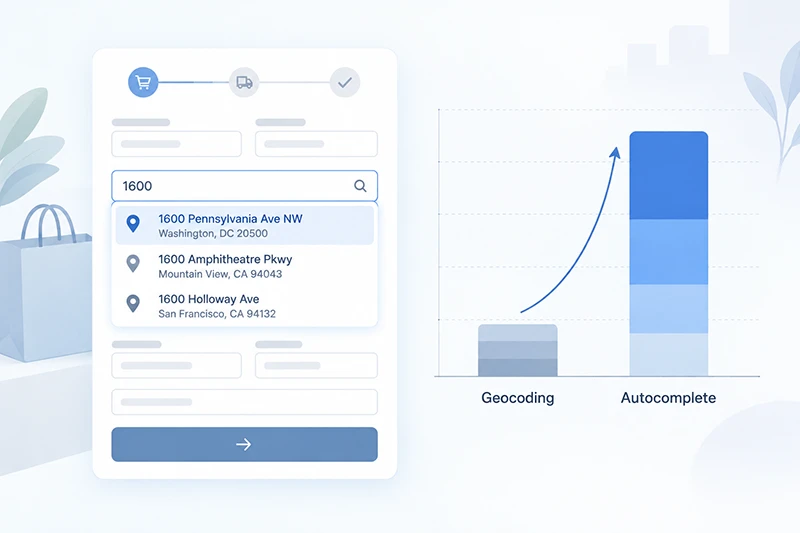
Most address flows do not start with a typed full address. They start with an autocomplete field, and the user picks a suggestion. How you turn that pick into coordinates decides what the whole session costs, and the geocoding line item on your invoice hides most of it.
Google bills autocomplete in sessions. A session starts with Autocomplete (New) and a session token, and it ends with a Place Details (New) call or an Address Validation call. What happens next depends on how it ends:
Ended with Place Details Pro or Enterprise: every autocomplete request in the session is free. You pay for the Details call: $17 per 1,000 at Pro, $20 at Enterprise.
Ended with Place Details Essentials: the Details call costs $5 per 1,000, but the first 12 autocomplete requests of the session are billed ($2.83 per 1,000 in the 10K - 100K tier). Requests 13 and above are free.
Not ended at all: if the session never reaches a Details or Address Validation call, autocomplete falls back to per-request billing.
A Geocoding API call does not close a session. So a common "cheap" pattern - autocomplete for suggestions, then the Geocoding API at $5 per 1,000 to get coordinates for the chosen text - leaves every session abandoned, and each autocomplete request is billed on its own.
The less obvious result is the Essentials termination. It looks like the budget option, $5 instead of $17. But each billed autocomplete request adds $2.83 per 1,000 sessions. The break-even sits at about four requests:
Autocomplete requests per session
Cost per 1,000 sessions, Essentials termination
Cost per 1,000 sessions, Pro termination
2
$5 + $5.66 = $10.66
$17.00
4
$5 + $11.32 = $16.32
$17.00
6
$5 + $16.98 = $21.98
$17.00
10
$5 + $28.30 = $33.30
$17.00
Rates from the 10K - 100K tier; free usage caps excluded.
If your users usually type five characters or more before picking a suggestion, the "cheaper" Details tier costs more per session than the Pro tier. Before you forecast geocoding spend, count autocomplete requests per session in your own logs. That one number decides which Google configuration is cheapest, and it is the number most pricing comparisons skip.
Woosmap Localities works differently: autocomplete does not require a session token, and no terminating call is needed to keep suggestion requests from being billed per session. Teams that resolve the picked suggestion with a Geocode call pay the Geocode rate in the table above, with no session state to manage.
Beyond the per-request price: terms that change the cost
Price per 1,000 is only part of the comparison. Three contract terms change what geocoding is worth to you.
Caching and display rules. Google's Maps Platform Terms of Service restrict caching, retaining and reusing geocoding results, and Google geocoding results cannot be displayed on a non-Google map. If you geocode a customer address once and want to store the coordinates for routing, analytics or delivery zones, read those clauses with your legal team first. A cheaper provider you cannot cache from can end up costing more than a pricier one you can.
Free usage is per SKU, not per project. Since March 2025 a project that uses Maps, Geocoding and Places draws on three separate free caps. A geocoding-heavy workload no longer benefits from unused map credit.
Data handling. Address queries are customer data. Under the General Data Protection Regulation, the address a shopper types at checkout is personal data, and your processor terms matter as much as the rate card. Google's terms, like those of other large platforms, allow end-user request data to be used to improve its products; the exact wording varies by product and should be reviewed before a migration. On the Woosmap side, the policy is short: Request data is used only to provide the service, then deleted or anonymized; it is never profiled or resold.
Platform position. Google also runs consumer services that compete with many of its Maps Platform customers. The EU's Digital Markets Act addresses gatekeeper self-preferencing in Article 6(5). That is not a reason to leave on its own, but it belongs in the risk column of a multi-year platform decision.
Google Geocoding API vs the alternatives
Google is not the only option, and the cheapest option is not always the right one. This table compares what matters for a geocoding workload.
Criterion
Google Geocoding API
Woosmap Localities Geocode
Mapbox Geocoding
HERE Geocoding & Search
OpenStreetMap Nominatim (public)
Free usage
10,000 requests/month
10,000 requests/month
100,000 temporary requests/month; no free tier on permanent geocoding
30,000 transactions/month on the Base plan
Free, under a strict usage policy
Price at 10K - 100K
$5.00 per 1,000
$2.04 per 1,000
Temporary: free up to 100K, then $0.75 per 1,000; permanent: $5.00 per 1,000
Free up to 30K, then EUR 0.70 per 1,000 (indicative, EUR; permanent geocoding not in the Base plan)
N/A
Storing results
Restricted by Google's terms
Check the Localities terms
Allowed only with permanent geocoding
Per HERE terms
Per ODbL attribution
Display on any map
No - Google maps only
Check the Localities terms
Per Mapbox terms
Per HERE terms
Per ODbL attribution
Batch requests
One address per request
Check the Localities documentation
Geocoding v6 batch endpoint, up to 1,000 queries per call
Separate batch geocoding service
One request per second maximum
Address precision
Rooftop where available
ROOFTOP accuracy; premium data in France and UK
Address-level
Address-level
Varies with OSM coverage
Coverage gaps
Global
Worldwide except China, Korea, Japan
Global
Global
Community-maintained
Sources: Google and Woosmap pricing pages as linked above; Nominatim usage policy; Mapbox pricing page and Geocoding API documentation (temporary and permanent geocoding rates, batch limit), read on 2026-10-07; HERE pricing page, Geocoding & Search Base plan, read on 2026-10-07. HERE shows its rates in euros and labels them indicative estimates, with the final price set by contract; we have not converted them to dollars. Google and Mapbox rates are in USD.
Three notes. Mapbox sells two geocoding modes: temporary geocoding is the cheaper one ($0.75 per 1,000 after 100,000 free requests), but its results may not be stored, while permanent geocoding ($5.00 per 1,000, no free tier) costs as much as Google's first paid tier and lets you keep the coordinates. HERE bills geocoding per 1,000 transactions after 30,000 free a month (EUR 0.70 per 1,000 up to 5 million on the Base plan, an indicative euro figure), and its Base plan does not include permanent geocoding. With both, check whether the rate you compare against Google allows the storage and display your architecture needs - a temporary rate you cannot cache from is not a like-for-like price. Mapbox's batch endpoint (up to 1,000 queries per call) matters if you geocode stored datasets rather than live input. And the public Nominatim service is a good fit for prototypes, but its usage policy caps you at one request per second and forbids heavy use, so production traffic means self-hosting it - which moves the cost from invoices to infrastructure and engineering time. For a provider-by-provider view, see our guides to Mapbox alternatives and Azure Maps alternatives.
How to choose: a decision table
Find your situation in one row.
Your situation
Recommended option
Why
Under 10,000 geocodes a month, already on Google Maps
Stay on Google
Inside free usage; switching cost exceeds savings
Address capture with autocomplete, users type 5+ characters
Google with Pro termination, or a provider with no session billing
Essentials termination costs more per session past 4 requests
50,000 - 500,000 geocodes a month, results shown on your own map
Woosmap or another provider without display restrictions
An estimated 41% of the Google line item at list rates, and no Google-map display rule
Batch-geocoding a stored customer or store file
A provider with batch support, or a cached pipeline you are allowed to keep
One-request-per-address pricing and caching limits add up on bulk jobs
Prototype or internal tool, low volume, no SLA needed
Nominatim (public) or self-hosted
Free, as long as you respect the usage policy
EU retailer with strict processor review
A provider whose request-data terms your DPO has approved
Data handling outweighs a few dollars per 1,000
If you sit in the third or fourth row, rebuild the cost table above with your own volumes before you scope a migration: the per-1,000 rates and free caps are all public.
How to cut your Google geocoding bill without migrating
Not every team should switch. If Google stays, four changes lower the bill:
Measure requests per session. Pull autocomplete requests per session from your logs and pick the session termination that is cheapest for that number, using the break-even table above.
Stop geocoding what you already know. Geocode store and customer master data once, within what the terms allow, rather than on every page view.
Validate input before you geocode. Malformed addresses that fail and get retried double your billable requests.
Watch tier boundaries. Volume rates apply only to the requests inside each tier, so a month that crosses 100,000 only gets the $4.00 rate on the requests above that line.
Google Geocoding API costs $5.00 per 1,000 requests between 10,001 and 100,000 requests a month, $4.00 per 1,000 between 100,001 and 500,000, and $3.00 per 1,000 between 500,001 and 1,000,000. The first 10,000 requests each month are free under the Essentials free usage cap. Above 1 million requests the rate drops to $1.50 per 1,000, and to $0.38 above 5 million. At 100,000 requests a month the bill is $450.
Partly. Since March 2025 each Essentials SKU, including Geocoding, gets 10,000 free requests a month. Beyond that every request is billed. The old $200 monthly credit that pooled across all Maps Platform APIs no longer exists, so free usage on Maps or Places does not cover geocoding. Small projects that stay under 10,000 geocodes a month pay nothing for this SKU.
Reverse geocoding (coordinates to address) is sent to the same Geocoding API endpoint as forward geocoding. Before you forecast a reverse-geocoding-heavy feature, check how those requests appear in your Google Cloud billing report and which free cap and volume tiers they count toward, so the feature does not push you into paid usage sooner than expected.
Usually because of autocomplete. If you resolve an autocomplete pick with the Geocoding API, the autocomplete session is never closed, and Google bills each autocomplete request individually. Ending sessions with a Place Details Essentials call bills the first 12 autocomplete requests per session. Measure requests per session and compare both termination options before you blame the geocoding rate.
Google's Maps Platform Terms of Service restrict caching, retention and downstream reuse of geocoding results, and Google results may not be shown on a non-Google map. Read the current terms with your legal team before you store anything. If your architecture depends on storing coordinates long-term, factor these rules into the cost comparison, not just the price per request.
It depends on the provider and your volume. Woosmap Localities Geocode is $2.04 per 1,000 requests after 10,000 free a month. Assuming graduated tiers, that is an estimated 41% of the Google line item between 50,000 and 500,000 requests a month, and about 45% at 1 million; confirm how your contract applies the tiers. Open-source Nominatim is free to self-host but moves cost to infrastructure. Compare at your own monthly volume.
Rarely, below 10,000 requests a month, because both options are free there. Between 50,000 and 500,000 requests, the estimated saving on geocoding alone runs from about $1,400 to $14,500 a year at list rates, assuming graduated tiers; it is an estimate, not a guaranteed saving. That often justifies a switch when combined with autocomplete and map costs, or when Google's display and caching rules block your architecture. Our guide to Google Maps API alternatives compares the full platforms.
Next steps
If you want the full stack picture - maps, autocomplete, details and routing together - read our store locator cost model at three scales. If you are ready to price your own volumes, start from the Woosmap per-request rates and rebuild the cost table with your own monthly volumes. For more on the company behind it, visit Woosmap.
This analysis was written by Jean-Thomas Rouzin, CEO of Woosmap. Jean-Thomas leads a European location intelligence platform serving 220+ enterprise clients across retail, logistics, and travel, processing 28B+ location context calls per year with a 99.9% SLA on the Enterprise plan.