

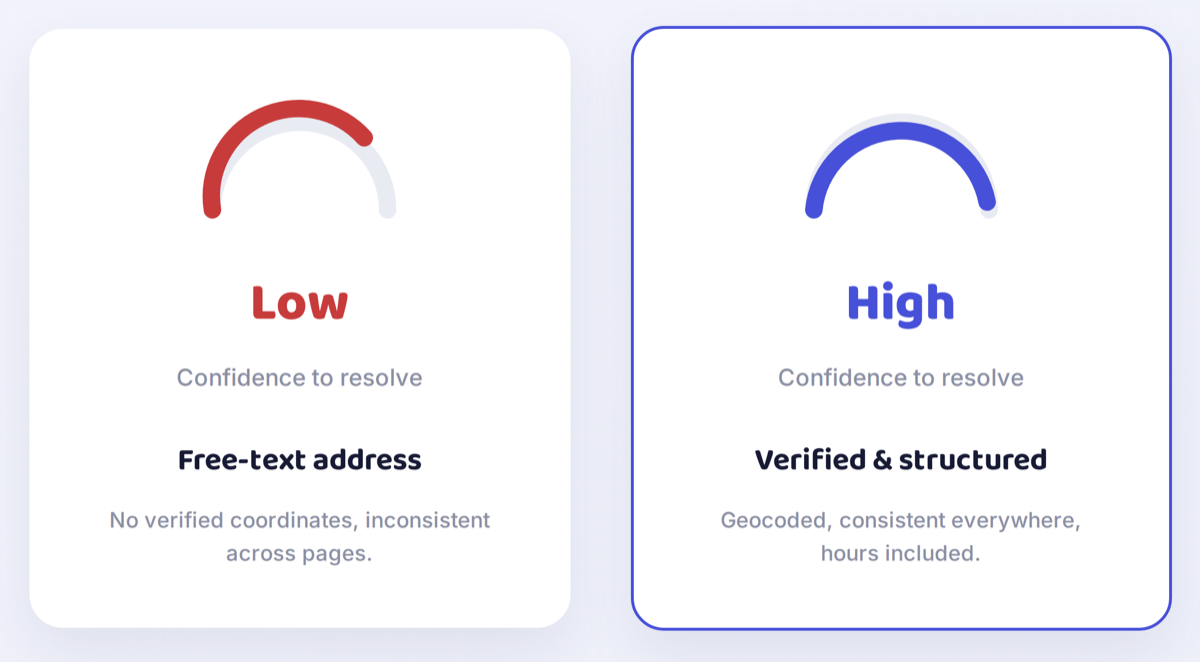
The same location written four different ways across your site is four locations as far as a machine is concerned. Verified, consistently structured addresses geocoded to the building resolve to one confident answer.
Get Picked by AI Assistants
When a customer asks an assistant where to buy, your stores need to be readable.
More local searches are starting inside an assistant instead of a search box. Those answers are assembled from structured location data, and if yours is incomplete or inconsistent, you are not in the answer.
The good news is that most of this is within your control: it comes down to how your addresses, opening hours and geographic context are structured. One store page is usually enough to see where the gaps are.
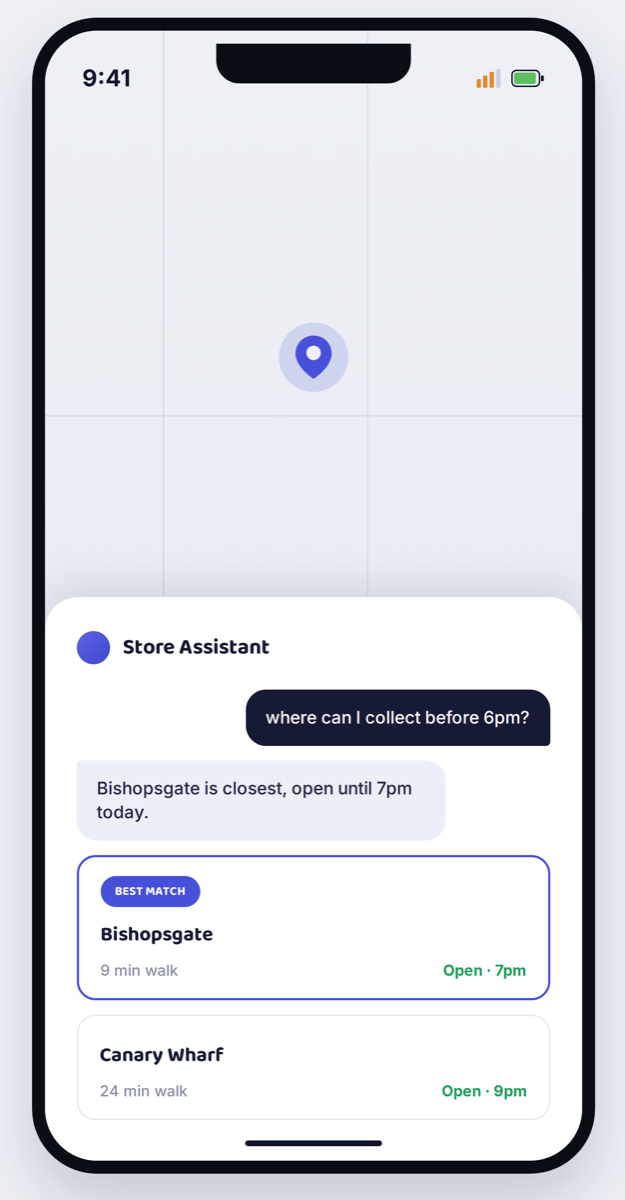
Local search moved, and the input changed
A customer used to type "shoe shop near me" and pick from a list of links. Now they ask an assistant and get one answer with two or three options.
Assistants pick the locations they can resolve with confidence, so being readable is now part of being findable.
Verifying and structuring your location data once, at the source, is what lets your store locator, local pages, app and API all give the same answer, and lets an assistant answer with confidence.
Four things that decide whether your location gets picked
One source of location truth, everywhere it needs to appear
Stores
Your locations, attributes and opening hours in one place, serving your store locator, your local pages, your app and your agents from the same record. Opening hours support the exceptions rather than assuming a fixed week.
Localities
Addresses verified and geocoded to building level, so every page states the same location the same way.
Spatial Context
Enrich local pages with real geographic context: what surrounds each location and what falls inside its catchment.
Distance
Travel times and reachable areas, so a page can answer how long it actually takes to get there rather than how far away it is in a straight line.
Store Locator
A fast, crawlable locator with a page per location, built on the same data.
Application areas
Retail and e-commerce
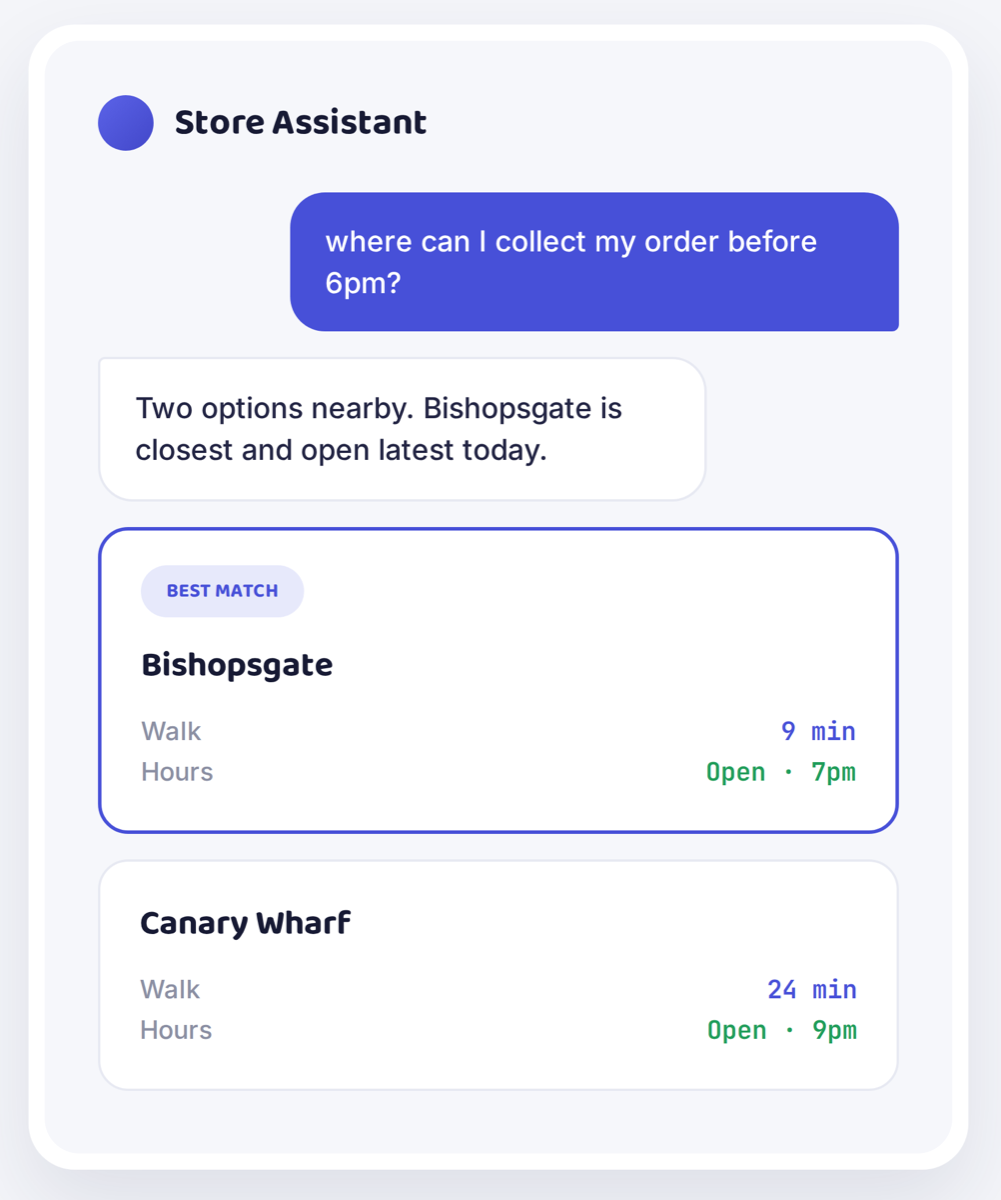
Local pages per store that answer stock, hours and collection questions consistently.
Hospitality and travel
Venues, sites and properties described with the context a guest actually asks about.
Health and wellness
Clinics and practices where accurate hours and accessibility detail decide whether someone turns up.
Public services
Service points, catchments and eligibility answered from real geography rather than a postcode list.
Automotive
Dealerships, service centres and charge points found by the customer standing nearest to them.
Why Woosmap
Resources
- Store Pages: one indexable local page per store, generated from your store data.
- Store Locator: a page per location, built on your own data.
- Spatial Context: geographic context for local pages.
- Location AI: giving your own agents accurate location data.
- Stores API: opening hours: how exceptions and seasonal hours are modelled.
Frequently asked questions
It picks the ones it can resolve with confidence. A location with a verified address, current hours and clear geographic context is easier to answer with than one that has gaps or contradictions.
It overlaps, and the goal is different. Local SEO optimises for ranking in a list of results. This is about being usable as an answer, which depends more on whether your location data is structured, complete and consistent.
Usually not. Most of the work is making sure the location data behind them is verified and consistent, and that hours handle exceptions correctly.
No. There is no submission process. Assistants read what is publicly available, so the work is making your own pages and data readable rather than pushing data anywhere.
The MCP Server is the other direction. That gives your own agents accurate location data. This is about other people's assistants being able to read your locations.
Not sure how readable your locations are?
Send us one of your store pages. One of our experts will tell you what an assistant can and cannot resolve from it, no commitment.