📅 Free webinar · 14 October, 11-11.30am BST (UK time)Will AI recommend your stores? Three moments that decide a saleSave your seat
What Is Address Validation? A Plain Definition for 2026
Jean-Thomas Rouzin - Reading time : 12 min
Table of contents
Address validation is the process of checking that a postal address actually exists, is formatted correctly for its country, and is precise enough to deliver to. It is the layer between "the customer typed something" and "we can charge a card, route a parcel, or open a bank account on that address". For ecommerce, logistics, and regulated industries, a soft handling of that layer is what fills inboxes with failed-delivery tickets and KYC exceptions.
The plain definition
When a customer types "12 Acacia Avenue, SW1A 2AA, UK" into your checkout, three things might be true at once: the address is real, the address is well-formatted for the United Kingdom, and the address is precise enough that a courier can find the door. Address validation is the operation that confirms or denies each of those, and returns a structured, cleaned version of the address with a confidence indicator the rest of your stack can act on.
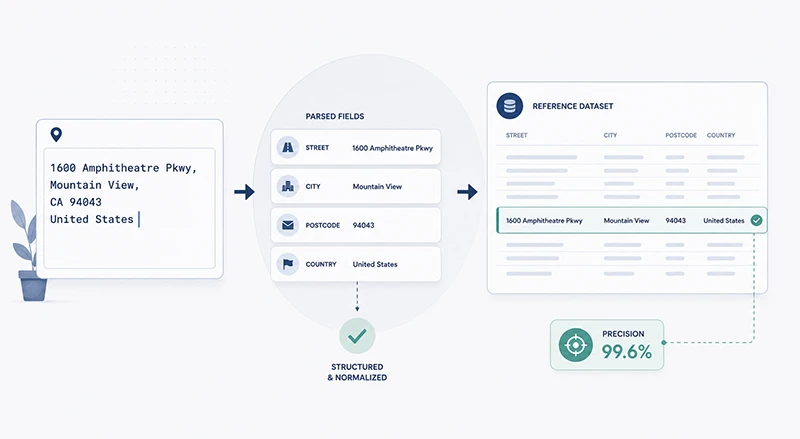
A good validator does four things on every call: it parses the raw input into the components the country uses (street number, street name, postcode, locality, region, country), it checks each component against a reference dataset, it corrects what it can confidently correct (typos, casing, spacing, postcode-locality mismatches), and it returns a status that tells the caller how trustworthy the result is. A weak validator does the first three and skips the fourth, which is how addresses look "validated" right up to the moment the parcel comes back.
Address validation vs verification vs geocoding vs autocomplete
The four terms overlap in everyday usage, and providers use them inconsistently. Pinning them down is worth a minute.
Address validation confirms that an input is a structurally correct, deliverable address and returns a cleaned, standardised version of it. The output is a structured address plus a status indicator.
Address verification is the equivalent term used by most US-anchored vendors, often tied to USPS CASS certification for domestic mail. In the United States the two words tend to mean the same thing in practice; in Europe, "validation" is the more common term and is not tied to a single postal authority.
Geocoding turns a validated address into a pair of coordinates (latitude, longitude) plus a precision tier (ROOFTOP, interpolated, centroid). Many providers expose validation and geocoding through the same API, but they are distinct operations. The bulk address geocoding patterns guide covers the geocoding side in depth.
Address autocomplete is a UX pattern that proposes complete addresses as the user types, usually backed by the same reference dataset as validation. The Google Place Autocomplete walkthrough walks through the developer-side mechanics.
The mental model that holds these together: autocomplete and validation prevent bad addresses from entering your systems, geocoding turns the good ones into actionable coordinates. Treating them as a single capability simplifies the procurement conversation but loses the resolution needed to negotiate intelligently.
How address validation actually works
Under the hood, a validator runs a pipeline over each input. The order varies between vendors, but the stages do not.
Parse. The raw string is broken into the components recognised by the country's address format. A French address like "12 rue de la Republique, 75011 Paris" parses very differently from a UK address like "Flat 3, 22 Acacia Avenue, SW1A 2AA", and very differently again from a Japanese address (which reads administrative-unit-first). Parsing is where most accuracy is won or lost on international traffic.
Match. The parsed components are matched against the underlying reference dataset for the country. The match step scores each candidate by closeness; the best candidate wins. Whether the dataset contains every address in the country, or only a sample, is the single most important fact about any address validator.
Correct. Where the input is close to a known address but slightly off (a postcode that does not exist but is one character away from one that does, a transposed street number, an outdated locality name), the validator may correct it and return the canonical form. Aggressive correction increases match rates and silently hides genuine input errors; conservative correction does the opposite.
Return. The output is a structured, standardised address plus a status indicator. Common status values include "verified", "verified with corrections", "ambiguous", "unverified", and provider-specific subcodes. The caller is expected to act on the status, not just on the cleaned text.
The match step is where data quality and country coverage decide whether the validator confirms the right building, the right street, or just the right postcode region. A validator that returns "verified" without distinguishing between those three is helping the parcel ship and the dispute ticket open in the same week.
Where address validation lives in a real product
A definitional article is only useful if the reader can place the concept in a product. Three places matter.
Checkout and account creation. Validation runs at the moment of address entry, often paired with autocomplete to remove friction. The objective is two-fold: catch errors before they enter the system, and capture the address in a structured form that downstream processes can rely on. Industry benchmarks from European ecommerce playbooks suggest up to +35% conversion uplift on mobile checkout after a generic address form is replaced with a search-as-you-type field tied to validated data. Treat that figure as an upper bound (customer-reported), but the direction is consistent across most reported deployments.
Customer-data hygiene. Validation also runs in batch, against existing customer databases, to clean stale or malformed addresses before a marketing send, a regulatory filing, or a migration. Batch flows have different rate-limit, caching, and pricing considerations from real-time flows even when they use the same API.
Compliance and KYC. In regulated industries (banking, insurance, telecoms, healthcare) the validated address is part of the customer record. Auditors want to see that the address was checked against a reference dataset at capture time, and that the provider's data posture is acceptable in the jurisdiction. "We validated it" is no longer enough on its own; the validation evidence travels with the record.
In each of those places, the validator's status indicator is the contract between validation and the rest of the system. Surfacing it consistently is the single highest-leverage habit in a validated address stack.
Why address validation matters for the business
A definitional article is rarely on a board's reading list, so it is worth being explicit about why this concept earns space in a procurement conversation.
Conversion
At checkout, the address field is the highest-friction step on mobile. Autocomplete-backed validation collapses that field into a few taps. The same European ecommerce benchmark cited above (up to +35% mobile checkout uplift) is, in practice, the headline number that gets validation onto a CFO's roadmap. Conversion teams now treat validation-grade autocomplete as table stakes rather than an upgrade.
Operations
In last-mile delivery, the difference between a validated, ROOFTOP-precise address and a "validated" centroid is the difference between a first-attempt success and a return-to-depot. Failed deliveries cost roughly EUR 15-25 each in reships, customer-service overhead, refunds, and the carbon footprint of repeated attempts. Operations directors running the numbers across a year rarely need to be sold the business case twice.
Data
Every address a customer types is unusually rich personal data: it ties a name and a purchase intent to a precise location. Where that address goes after the validator accepts it - which infrastructure hosts the request, which company can use the data for its own ad ecosystem, which jurisdiction the data crosses - is a procurement question that DPOs and CFOs ask before signing. It is also why the Digital Markets Act on EUR-Lex recognises self-preferencing risks under Article 6.5 - a structural fact worth verifying with legal before locking in any provider.
Common pitfalls in address-validation deployments
The conceptual model is simple. The failure modes are not.
Treating "verified" as binary. Most providers return finer-grained status values (verified, verified-with-corrections, ambiguous, unverified). Code that collapses them into a single boolean throws away the signal that lets fraud, fulfilment, and customer-service teams make different decisions on the same address.
Country-format blind spots. A validator that performs well on US suburban addresses can perform visibly worse on UK, Irish, French, or Japanese addresses. The UK address format guide covers the formatting traps that lose UK accuracy when a generic validator is used.
Over-aggressive correction. Auto-correcting a postcode is helpful when the customer typed the wrong digit, and harmful when it silently maps an in-error address to a real one nearby. The audit trail (what was typed, what was corrected, what was returned) needs to be persisted with the order, not just the corrected output.
Caching and licence rules. Some providers' Terms of Service restrict how validated results may be stored, for how long, and in which downstream systems. Reviewing those terms before designing the persistence layer is cheaper than reviewing them after launch.
Per-keystroke versus per-session billing. Autocomplete-style typeahead is where most validation cost shows up. Some providers bill per request; some bill per completed session; some are free at a tier and per-request after. The decision matters at scale and is not always evident from the pricing page headline. The HTML5 autocomplete attribute reference on MDN documents the browser-level conventions that providers layer this billing on top of.
Privacy posture mismatch. Address queries that route through US infrastructure are a GDPR conversation waiting to happen for EU customers. EU-hosted address-validation providers exist, but verifying that posture is a procurement step, not a marketing claim to be taken at face value.
Tools and providers (vendor-neutral overview)
Several mature options exist; the right choice depends on what you are optimising for. This is a definitional article, not a buyer's guide - the address verification software comparison is the closer ranked review when you are ready to evaluate.
Loqate. A long-standing global address-validation specialist (part of GBG), covering more than 245 countries and territories. Validates and corrects addresses after user entry and is CASS certified for US addresses. Often the reference point when "address validation" is the only thing the project is buying.
Smarty. US-anchored, with CASS certification and a strong autocomplete UX. The international tier has expanded but the centre of gravity remains US deliverability.
Melissa. Broad coverage of postal datasets across many countries, with a portfolio that extends into data enrichment and identity verification. Useful when validation is part of a wider data-quality programme.
Google Address Validation API. Recent addition to Google Maps Platform, attached to the same session-token billing model as Place Autocomplete. Strong global match rates; the procurement notes are the same as any other Google Maps Platform component (data flow through Google infrastructure, caching restrictions).
Woosmap Localities. EU-hosted location platform. The Localities API family covers Address Validation for UK and Ireland premium addresses (available on Pro and Enterprise plans), free Localities Autocomplete at all volumes, and Localities Geocode with ROOFTOP precision worldwide except China, Korea, and Japan. Premium precision in France and the UK uses official local data providers. The address verification free tool overview is the closest service-page entry point. Developer-side detail lives at the Localities API getting-started guide.
The honest answer to "which one should we pick?" lives in a scored RFP that weighs precision tier, country coverage, billing model, data posture, and total cost across realistic traffic scenarios - not in a single definitional article.
What this means in 2026
Address validation is no longer a back-office utility. It sits on the path of every mobile checkout, every customer onboarding, every last-mile route, and increasingly every regulated record that needs an auditable origin. The teams that treat it as a single procurement question ("which API?") tend to miss the harder questions ("at what precision tier? in which markets? with what status taxonomy? routing through which jurisdiction? on which billing model?").
If your roadmap touches address entry, delivery, or compliance, validation is worth understanding at the level of this article. Developers ready to look at the implementation view can start with the Google Place Autocomplete walkthrough; decision-makers can use the address verification free tool overview to feel the capability in their hands before scheduling any vendor conversation.
Frequently Asked Questions
In practice, both terms mean checking that an address exists, is formatted correctly, and is deliverable. In the US, "address verification" is the more common term and is often tied to USPS CASS certification. In Europe, "address validation" is the more common term and is not tied to a single postal authority. Most providers use the terms interchangeably; what matters is the underlying behaviour and the country coverage, not the label on the API.
No. Address validation checks that an address is real and deliverable, and returns a cleaned structured version. Geocoding turns a validated address into a latitude/longitude pair, plus usually a precision tier such as ROOFTOP (street-address-level), interpolated, or centroid. The two operations are complementary and most providers expose them through the same API, but the outputs and the failure modes are different.
It depends on the provider, the country, and the underlying reference dataset licensed for that country. In well-covered markets (US, UK, Ireland, France, Germany) match rates above 95% on clean inputs are common. In less-covered markets, match rates drop and the provider's choice of dataset becomes the dominant factor. Asking for per-country match rates in the RFP - not a single global headline number - is the only way to compare seriously.
Most autocomplete implementations validate as a side effect, because the suggested address comes from the same reference dataset that a validator would check against. But not all autocompletes are equivalent: some propose any string from the dataset, some only propose deliverable addresses. Confirming what is propose-able and what is not is part of evaluating an autocomplete component for use as the validation layer.
Pricing models vary widely. Some providers bill per validation request; some bundle validation into a per-session price that also covers autocomplete; some have free tiers up to a volume threshold (Woosmap Localities, for example, has up to 10,000 free API requests per month on most APIs). Total cost at scale is usually dominated less by the unit price of a single validation call and more by the combination of validation, autocomplete, and any Place Details calls in the same checkout flow. A realistic total-cost model should include all of those across at least three traffic scenarios, not just the headline validation rate.
Yes, but only with providers who explicitly support it. Some providers route all requests through US infrastructure regardless of customer location. Others offer EU hosting as a default or as a tier. If GDPR posture matters to your business, EU hosting is a procurement question to verify on each provider's legal documentation, not something to assume.
In regulated industries, the validated address is part of the customer record. Auditors want to see that the address was checked against a reference dataset at capture time, that the result was persisted with the order (including any corrections the validator applied), and that the provider's data posture is acceptable in the jurisdiction. Validation alone is not KYC, but a robust validation step is one of the building blocks that a defensible KYC programme rests on.