📅 Free webinar · 14 October, 11-11.30am BST (UK time)Will AI recommend your stores? Three moments that decide a saleSave your seat
Retail Location Intelligence in 2026: A Practical Guide
Jean-Thomas Rouzin - Reading time : 11 min
Table of contents
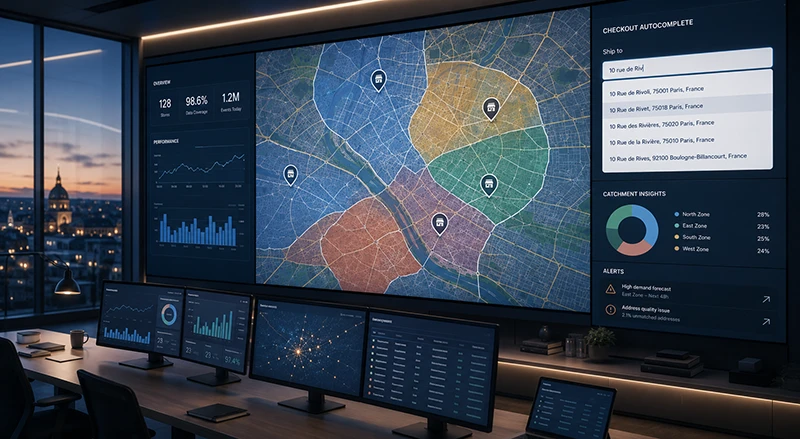
Retail location intelligence is the practice of turning spatial data - stores, customers, deliveries, competitor sites, live movement - into decisions that move revenue. In 2026, the strongest returns do not come from another analytics dashboard. They come from spatial capabilities wired directly into checkout, store search, delivery ranking, and local pages. This guide is a decision-maker briefing on what has changed, what to build, and where the money actually is.
What retail location intelligence means today
Location intelligence used to be a corner of business analytics: static maps in a monthly board pack, catchment zones drawn once a year, competitor site overlays used at store-opening committee. That layer still exists and still matters. It is not the whole picture anymore.
Modern retail location intelligence spans four layers:
Spatial data. Points of interest, road networks, address graphs, catchment polygons, live movement signals, and increasingly first-party signals from your own apps and stores.
Analytics and reporting. The classic layer - dashboards for the network team, catchment refreshes, competitive site scoring, footfall attribution.
Operational APIs. The layer most retailers under-invest in. Address autocomplete, geocoding, distance and isochrone, store search, and map rendering, called from your ecommerce and app stacks in production.
Local content and discovery. Store finder pages, dealer locator pages, local landing pages built to rank on local intent and to be cited by AI answer engines.
A "retail location intelligence" strategy that only touches layer 2 is the exception, not the rule. The teams generating the biggest business impact treat layers 3 and 4 as first-class - because that is where customers actually meet the brand.
Why decision-makers cannot ignore this in 2026
Three forces have pushed retail location intelligence from a specialist concern to a C-suite topic.
First, the checkout is the cheapest place to grow revenue. Every failed address on an ecommerce order costs the retailer more than a marketing click ever earned. Industry benchmarks routinely report that better address capture and geocoding at checkout lift mobile conversion by double-digit percentages; European marketplaces have publicly reported uplifts up to +35% on mobile checkout after switching to modern autocomplete. Fixing that flow is a location intelligence project first, not a UX cleanup.
Second, local intent is where AI answer engines look for authority. ChatGPT, Perplexity, and Google AI Overviews cite pages that carry real spatial context - proximity signals, neighbourhood context, transport data, verified store hours. Local pages that read like generic templates get skipped. This is a new tax on retailers with thin local content: your top-of-funnel visibility now depends on spatial signals your competitors are already publishing.
Third, the price of getting the stack wrong has gone up. Google Maps Platform pricing changed materially over the last three years, per-load and per-request billing has replaced pooled credits, and retailers deploying at scale routinely see mapping and geocoding costs move from a rounding error into a real operating line. That has forced boards to ask what they are actually paying for, and to look at how retail location intelligence is priced across Google Maps API alternatives, Mapbox, HERE, TomTom, and independent platforms.
The retailers who benefit most in 2026 stop asking "which dashboard?" and start asking "which capabilities do we own, which do we rent, and where do we integrate them?"
Where the retail ROI actually shows up
For a decision-maker, the point is not the map. The point is the decision the map lets someone make. In retail, four decisions carry the majority of the ROI.
Where should a customer buy from you today? Store selection - correctly ranked by real travel time rather than straight-line distance - is the single biggest lever for click-and-collect conversion. A store 1.2 km away in dense city traffic is not closer than one 2.4 km away on a ring road, and treating those as equal costs orders every week. Location intelligence turns "nearest store" into "shortest actual trip", which is a different question with a different answer.
Where does your delivery promise actually hold? Failed deliveries and returns driven by wrong or ambiguous addresses are a well-documented cost centre. For a mid-sized retailer, six-figure annual savings on failed deliveries are a realistic outcome from address validation and rooftop-level geocoding at capture time - not from another warehouse process fix.
Which local pages should you invest in? Not every store deserves the same page. Retail location intelligence tells you which locations sit on winnable local queries, which have thin content compared to competitors, and where the AI-cited pages come from in your category. That decides the CMS backlog for the next six months.
Where should the next store, dark store, or pickup point go? The classic analytics question is still there. It is now enriched with live movement data, competitor site density, and cross-channel signals from your own ecommerce - moving site selection from "annual exercise" to "quarterly refresh".
Every one of these decisions is spatial. Not all of them live in the analytics team.
What a modern retail location intelligence stack looks like
The stack has become opinionated. A retailer running location intelligence well in 2026 typically owns or rents four capabilities.
Capability
What it does for retail
Where it is called from
Address autocomplete and geocoding
Suggests and validates addresses at checkout, account creation, and delivery entry; produces rooftop-level coordinates
Ecommerce checkout, mobile app, account forms
Store search and distance
Ranks stores or pickup points by real travel time, isochrones, or hybrid criteria
Store locator, product page availability, click-and-collect selector
Map rendering
Displays stores, delivery zones, dark stores, or dealer networks with fast, customisable maps
Build vs. rent. In-house mapping, geocoding, and address services are technically possible and structurally expensive. The maintenance cost of address data, road networks, and country-specific formats is not a one-off. Every month spent maintaining an in-house geocoder is a month not spent on the retailer's core product. Most modern retail teams rent the platform layer and build the retail logic on top.
Bundle vs. specialist. Some retailers rent everything from one provider (Google Maps Platform is the default). Others rent by capability - a location platform for autocomplete and store search, a data provider for footfall analytics, sometimes a dedicated address verification tool for one specific market such as the UK. Both patterns work. The decision usually comes down to pricing structure, data control, and how much of the checkout you want going through a single vendor's infrastructure.
What decision-makers should scrutinise
If you are the person signing the contract, the following questions catch most of the failure modes.
How is the pricing structured at your real volume, not the free tier? Free tiers are useful for prototypes. They are misleading for budgeting. Ask each vendor for a per-1,000-request quote at your projected annual volume across the specific capabilities you will use, and ask for the paid-tier price too - free-tier headlines rarely survive contact with an ecommerce peak.
Who owns the location data your customers hand you? When a customer types their delivery address into your checkout, that address is a valuable signal. Some providers' terms of service allow them to use those signals to improve their own products and, in some cases, to feed adjacent advertising ecosystems. The specifics vary by product and by clause - the point is to read the terms with your DPO and Legal before scale, not after. Data control is a governance question, not a marketing claim.
Where is the infrastructure hosted? For a European retailer, whether the calls to a location API route through EU or US infrastructure is a Schrems II conversation, not a nice-to-have. Ask for the hosting map and the sub-processor list.
What does support look like at 2 a.m. on Black Friday? Not the roadmap slide. The actual contract: named engineers, response times, escalation path, and whether you are talking to a real team in your timezone or opening a support ticket you might read tomorrow.
Where is the vendor lock-in? The safest question you can ask a vendor is: "If we decided to leave in twelve months, what does that migration look like?" Answers matter more than promises here.
Common pitfalls
Three failure patterns show up repeatedly across retail programmes.
Confusing dashboards with capabilities. A polished analytics dashboard on top of location data does not, by itself, move revenue. It surfaces a signal. The signal only becomes revenue when it changes something operational - a store selection algorithm, a delivery ranking, a local page's content. If a location intelligence programme has no downstream integration in checkout, store search, or the CMS, it is a report subscription.
Treating store locators as SEO widgets. Store finders are commonly outsourced to a template widget bolted on years ago. In practice, the store locator is a conversion engine - it is where a curious visitor becomes a footfall event or a click-and-collect basket. Retailers that measure store locator sessions properly usually find they are one of the highest-converting flows on the site, and worth the same engineering attention as the cart.
Under-serving international markets. Address formats in the UK, Ireland, Italy, Spain, and increasingly in central Europe do not behave like US addresses. A single generic autocomplete tuned for the US will silently degrade conversion in those markets. If you sell in more than one country, ask each vendor about country-specific data and premium coverage - HERE, TomTom, and specialist providers such as Loqate publish coverage that varies by market and by SKU.
Tools and solutions
Retail decision-makers usually evaluate three types of provider:
Consumer-first mapping platforms such as Google Maps Platform and, in an automotive-adjacent lane, Mapbox. Broad reach, strong consumer brand, pricing structured around the platform vendor's own business. Widely deployed as the default, increasingly reviewed as scale costs rise.
Enterprise mapping and location data platforms such as HERE, TomTom, and Woosmap. Purpose-built for enterprise deployments, with commerce-facing APIs (autocomplete, geocoding, distance, store search), and pricing structures aimed at recurring workloads.
Specialist data and analytics vendors such as Placer.ai, Precisely, and Esri on the analytics side, and Loqate on the address verification side. Strong in their vertical, usually complementary rather than substitutable with the platform layer above.
Woosmap is one of the platforms in the enterprise category - European location intelligence platform, 220+ enterprise clients across retail, automotive, logistics, travel, hospitality, and marketplaces, 28B+ location context calls processed per year, 99.9% enterprise SLA, and EU-hosted infrastructure. It is one option among several; the right pick depends on your markets, your integration surface, and where in the stack you want to consolidate.
For a broader vendor-by-vendor comparison, our Google Maps API alternatives review walks through pricing structures, coverage, and typical trade-offs across the platform layer. For a deeper look at one of the closest platform peers, the HERE Technologies alternatives briefing covers the enterprise mapping category in more detail.
Getting started: how to evaluate
The lowest-risk way to run this evaluation is boring on purpose.
Inventory the retail flows that already touch location: checkout, store finder, click-and-collect, delivery ranking, local pages, and any analytics dashboard consuming spatial data. You will typically find between six and twelve.
Rank by impact, not by novelty. Checkout and store selection nearly always outrank a new footfall dashboard.
Score current cost and current control: what are you paying today, what data are you handing over, and what happens if that provider changes terms in Q3?
Ask three vendors for real pricing at your volume, hosting map, terms of service, and support model. Include one platform vendor, one specialist, and your incumbent.
Migrate one flow first. Store finder or address autocomplete are the usual first moves - they are visible, measurable, and reversible. Global cut-overs rarely go well.
Most retail teams get to a clear picture in six to eight weeks. The compounding value starts once the second and third flows migrate onto the same layer.
Frequently Asked Questions
Retail location intelligence is the use of spatial data - stores, customers, deliveries, catchments, movement signals - to drive retail decisions in ecommerce, store operations, marketing, and network planning. In 2026 it spans four layers: spatial data, analytics and reporting, operational APIs called from your stack, and local content and discovery.
GIS (geographic information systems) is the toolkit for storing, analysing, and visualising spatial data. Retail location intelligence uses GIS concepts but is defined by the business outcomes it drives - conversion, store performance, delivery accuracy, local SEO - and by the operational integration into retail systems, not by the underlying software category.
No. The analytics layer benefits from data expertise, but most of the retail ROI - checkout autocomplete, store search, delivery ranking, local pages - is engineering and product work using APIs from a location platform. A small integration team gets meaningful results in a quarter.
AI is useful in two places. First, spotting patterns in spatial data that a human dashboard misses - demand surges, catchment shifts, allocation opportunities. Second, on the visibility side, AI answer engines increasingly reward local pages that carry real spatial context and cite verified sources. Neither replaces the platform layer; both sit on top of it.
For European retailers handling personal data at checkout, yes. Post Schrems II, the routing of customer addresses through US infrastructure is a governance question that Legal and DPO should own. Ask each provider for the hosting map and sub-processor list, and note that the answer differs by product line within the same vendor.
Technically yes, structurally rarely worth it. Maintaining address data, road networks, and country-specific formats is a full-time programme. Most retail teams that started with in-house builds five years ago now buy the platform layer and build retail-specific logic on top - the coverage gaps and maintenance cost tend to outweigh the perceived control.
For a mid-sized European retailer running checkout autocomplete, store search, delivery ranking, and a store locator, platform costs typically land in the low five figures per year, with heavier consumers scaling into six. Compare like-for-like against your incumbent using the specific SKUs you will call - free-tier headlines rarely reflect the paid reality.
Next steps
Retail location intelligence in 2026 is not a dashboard decision - it is a stack decision that touches conversion, cost, and data control at the same time. If you want to pressure-test your current stack against a European platform designed for retail, talk to our team and we will walk through the checkout, the store locator, and the coverage map with you.
This analysis was written by Jean-Thomas Rouzin, CEO of Woosmap. Jean-Thomas leads a European location intelligence platform serving 220+ enterprise clients across retail, logistics, and travel, processing 28B+ location context calls per year with a 99.9% SLA on the Enterprise plan.