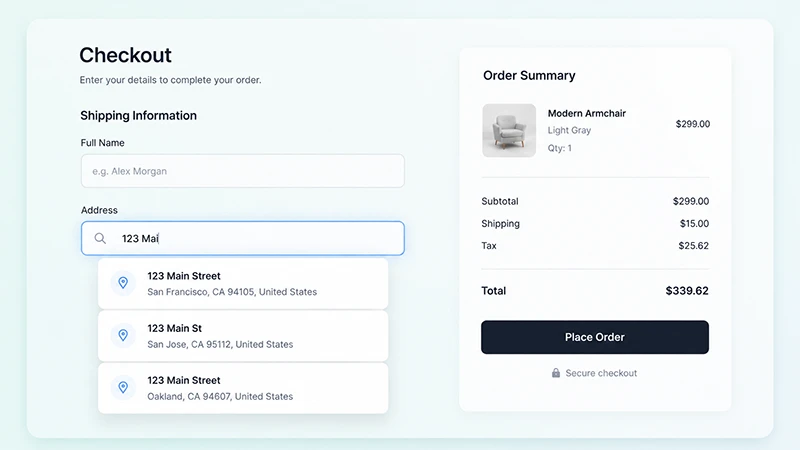
A places autocomplete API is the technology that turns a single search field on your site - a checkout address field, a store finder, a marketplace location filter - into a live dropdown that predicts what the user is looking for as they type. For decision-makers, the meaningful question is rarely "what does it do" but "where does it move the business numbers". This guide explains the category, why it sits on the conversion path, and what to look at before buying.
What a places autocomplete API actually is
A places autocomplete API predicts and resolves what a user is typing into a search field, in real time, against a structured location dataset. The "places" in the name matters : the dataset typically includes more than street addresses. It covers points of interest (a restaurant, a school, a gym), administrative areas (a neighborhood, a city, a region), business establishments, and full postal addresses. The API returns a ranked list of candidates after each keystroke, and resolves the selected candidate into a normalized record with coordinates.
The category is sometimes used interchangeably with "address autocomplete API", but they are not the same scope. An address autocomplete API is narrower : it predicts only valid postal addresses, which is what a checkout form usually needs. A places autocomplete API is broader and is what a marketplace, a travel site, or a store finder needs when the user might type "Hilton near Times Square" or "downtown Madrid" rather than a complete street address.
The branded name "Places Autocomplete API" most often refers to Google's Places API Autocomplete service, which popularized the pattern. Today, every serious location platform - Woosmap, Mapbox, TomTom, HERE, Azure Maps - ships an equivalent capability, sometimes under a different product name. The category, not Google's specific implementation, is what matters when you are evaluating it as a business decision.
Why the category sits on the conversion path
A places autocomplete API is one of the few pieces of infrastructure that touches the checkout, the search, and the location-aware product discovery flow at the same time. That is why it shows up in the conversion conversation more often than any other piece of location tooling.
Three reasons stand out.
First, the checkout cost of typing. When a user types a delivery address by hand at checkout, the abandonment risk rises with every character. Industry research on form friction (e.g., the Baymard Institute checkout usability studies) has repeatedly shown that complex address forms are a top driver of cart abandonment in e-commerce. A places autocomplete field collapses that into one search box that auto-fills the rest. Industry benchmarks for a one-field address capture cite up to 35% conversion uplift on mobile checkout - an upper bound, not an average, and dependent on the baseline form quality.
Second, location-aware search. On a marketplace - real estate, mobility, home services, travel - the user does not always know the exact address. They type "near Bordeaux", "5th arrondissement Paris", "Soho London". A places autocomplete API recognizes administrative places and points of interest, not just street addresses, and produces results the user actually meant. Without it, the marketplace either fails to find anything or returns over-broad results, both of which depress engagement.
Third, store and service discovery. A retailer with a store locator, a quick-service brand with click-and-collect, a service business with technician dispatch - all of them need the customer to express "where am I, where do I want to go" in a single field, with no error. The same places autocomplete capability that powers the checkout powers the locator, which is why a single piece of infrastructure usually serves several outcomes in the same business.
For context, Woosmap's published narrative frames these as three measurable outcomes : acquisition (local pages that rank), engagement (location-aware search with industry-benchmarked add-to-cart lifts), and conversion (one-field address capture). The numbers are upper bounds drawn from real customer engagements, not guarantees. The point is that the same technology surface participates in more than one revenue moment, which is why decision-makers tend to evaluate it as platform infrastructure rather than as a tactical fix.
How a places autocomplete API works at a high level
You do not need to read code to evaluate this category, but it helps to understand the shape of the integration. The pattern is the same across providers.
A user starts typing in the address or search field. After a short pause - typically 200 to 300 milliseconds, called "debounce" - the front end sends the partial query to the autocomplete endpoint. The endpoint returns a ranked list of candidates : a few addresses, possibly a few points of interest, possibly a few places. The dropdown shows the candidates. The user clicks one. The front end then either uses the data already returned in the candidate, or makes a second "details" call to resolve coordinates and normalized address components.
Two practical points matter for a business decision.
One, the dropdown is the experience. The quality of suggestions - their relevance, their freshness, their coverage in your target markets - is what users feel. A places autocomplete API that returns three plausible results in 150 milliseconds is invisible to the user, which is what you want. A slower or noisier dropdown is felt as friction and shows up in abandonment metrics.
Two, the integration is not a project. A typical first integration on a single form is half a day to a day of engineering time for a developer who has done it before. A production rollout across a checkout, a store locator, and a marketplace flow is usually two to four weeks of work, with the longest portion being address-format normalization across markets, not the API integration itself. That timeline holds across every reputable provider in the category.
What to evaluate before buying
The marketing pages of every places autocomplete provider sound similar. The differences that move the budget conversation sit at a layer below the feature list.
Where the request is processed. A places autocomplete query is, by definition, location data about a user. For European businesses, where the request is processed and what the provider does with the payload becomes a question for the DPO. Some providers (Woosmap) operate fully European-hosted infrastructure. Others (Google, Mapbox) route through US infrastructure, which becomes a GDPR Article 44 question on transfers to third countries. The answer depends on your data protection impact assessment, not on any vendor's pitch.
The pricing model, not just the rate. Two providers can publish identical headline rates and produce wildly different invoices in production. The questions to ask : is autocomplete itself metered, or free? Is there a session-token mechanic that bills differently if the session is abandoned? What does the "details" call cost separately? At scale, these structural choices, not the headline rate, drive the invoice. Localities Autocomplete from Woosmap is free at all volumes per the published pricing ; Google's autocomplete is free under session billing when the session terminates on Pro or Enterprise tiers and reverts to per-request when abandoned. Both are defensible models. They produce different invoices.
Coverage in your real markets. "Worldwide coverage" is a marketing claim. Every provider has weaker countries. The honest evaluation is to run a 100 to 500 address sample test against the markets you actually ship to and measure the rooftop-level hit rate, the relevance of the top three suggestions, and the percentage of malformed responses. Forty-five minutes of engineering produces a comparison spreadsheet that is more useful than any vendor pitch.
Premium address data where it matters. In the United Kingdom and Ireland, official address datasets - PAF for the UK, Eircode for Ireland - deliver a granularity that generic worldwide geocoding cannot match. If your business operates in those markets, the question is whether the autocomplete provider exposes PAF and Eircode resolution. Some do (Woosmap on Pro and Enterprise plans, Loqate as their core product). Some do not.
What happens after the user picks. Some providers return the geocoded address directly in the autocomplete response. Some require a separate "details" call that is billed independently. For a checkout, the difference is one round trip per user, which compounds at scale on both latency and cost.
Mobile coverage. If your business has a mobile app, the question is whether the provider ships native iOS, Android, Flutter, and React Native SDKs that wrap the same capability. Every reputable provider does, but the maturity and the API ergonomics vary.
A short note on Google's Places Autocomplete specifically
Because "Places Autocomplete API" is most often associated with Google, it is worth being explicit about when Google's version is the right answer and when it is not.
Google is the right answer when : you already run Google Cloud, your customers are primarily in the United States, your team is fluent in the Google Maps Platform billing model, and your data protection assessment accepts requests routed through US infrastructure.
Google is worth evaluating against an alternative when : you operate in European or UK markets with strict GDPR posture, you need premium UK or Irish address resolution, you need session pricing predictability across abandoned checkout flows, or you want a single per-1000-request invoice model rather than session-and-SKU billing. None of these are accusations against Google's product - they are structural choices that match different business contexts.