

Is the Google Maps API key actually free? A 2026 breakdown
Table of contents
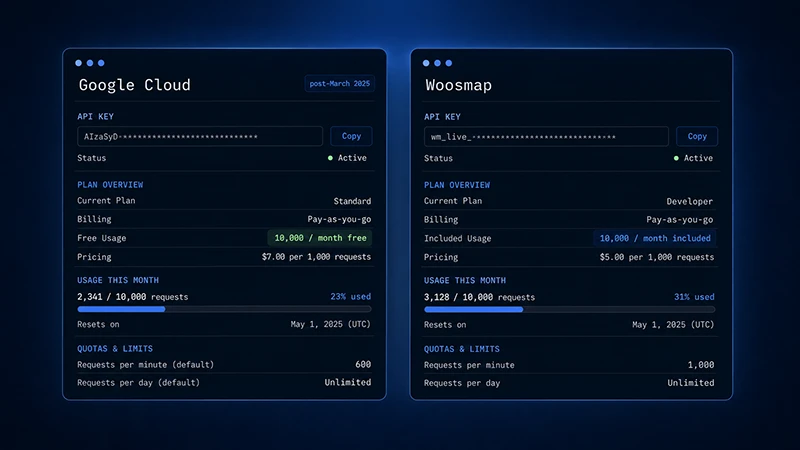
"Free Google Maps API key" is the search every developer types before they ship a map. The honest answer in 2026 is: yes, the key itself is free to create, and Google's per-SKU free tier covers small projects. No, the API calls are not unconditionally free, and the way Google bills changed materially in March 2025.
This guide walks through what you actually get without paying anything, where the meter starts under the post-restructure model, and how Woosmap's free tier compares for the same workloads.
What "free" means for Google Maps Platform in 2026
Google Maps Platform issues an API key for free through the Google Cloud Console. Creating the key, restricting it to specific APIs, and rotating it costs nothing. There is no credit card required to generate the key.
The free part stops at usage, and the shape of "free usage" changed in March 2025.
Before March 2025, Google attached a single $200 monthly credit to the billing account behind every API key. A team calling Maps, Geocoding, and Places could absorb roughly $200 of mixed usage before paying anything.
Since March 2025, the flat $200 credit was replaced with per-SKU free caps and three subscription plans bolted on top of pay-as-you-go rates. Each SKU gets its own free allocation rather than sharing a single pooled budget:
- Essentials SKUs (Dynamic Maps, Static Maps, Geocoding, Place Details Essentials, Autocomplete per-request, Compute Routes Essentials, Route Matrix Essentials) get 10,000 free events per month.
- Pro SKUs (Dynamic Street View, Aerial View, Place Details Pro, Address Validation, Text Search, Nearby Search, Compute Routes Pro) get 5,000 free events per month.
- Enterprise SKUs (Photorealistic 3D Tiles, Fleet Routing, Navigation) get 1,000 free events per month.
Free usage no longer pools across APIs. A store locator using four Essentials APIs gets 40,000 free events total - but only 10,000 per API. You blow through the Map Loads cap before you blow through the Geocoding cap, and the meter starts ticking on whichever one runs out first.
On top of pay-as-you-go, Google introduced three subscription plans that bundle a fixed number of map loads at a discounted effective rate:
| Plan | Monthly cost | Included map loads | Effective rate |
|---|---|---|---|
| Starter | $100 | 50,000 | $2.00 per 1,000 |
| Essentials | $275 | 100,000 | $2.75 per 1,000 |
| Pro | $1,200 | 250,000 | $4.80 per 1,000 |
Subscriptions cover Essentials and Pro SKUs at bundled volumes; Enterprise SKUs (Fleet Routing, Navigation, Photorealistic 3D Tiles) remain pay-as-you-go on top of any plan. None of the three plans is required: a team can stay entirely on per-SKU caps + per-request rates if that fits the workload better.
Two mechanics also matter for the meter once you cross a free cap:
- Most SKUs are priced per request, so the meter ticks every time your front end calls Places Details, Geocoding, or Map Load above its per-SKU cap.
- Autocomplete uses session billing. A session starts with Autocomplete (New) plus a session token and is normally terminated by a Place Details (New) request or by Address Validation. The way the session ends decides whether the autocomplete keystrokes inside it are free.
The session detail is the part that catches teams out. If the session terminates with Place Details on the Pro or Enterprise tier, every Autocomplete call in that session is free (the Autocomplete Session Usage SKU is $0 at all volumes). If it terminates on Essentials, the first 12 Autocomplete calls in the session are charged at the Autocomplete Requests rate ($2.83 per 1,000 at the 10K-100K tier) and the 13th onwards are free. If the user abandons before any Place Details call, the autocomplete keystrokes revert to per-request billing.
In other words: a real-world checkout flow can look fully free in test and produce a four-figure monthly Autocomplete bill in production, purely because a meaningful share of users abandon address forms before completing them.
How the free tier behaves under real workloads
Three patterns burn through the per-SKU caps quickly.
The first is map embeds. A single page view that loads a Dynamic Map fires a Dynamic Maps SKU, which is an Essentials-tier SKU with a 10,000 free event monthly cap. A homepage with a store finder above the fold can serve hundreds of thousands of Map Loads per month before any user interacts with the map, exhausting the 10,000 cap inside a single day of moderate traffic and pushing the overage into per-request billing ($7.00 per 1,000 at the 0-100K tier) or into the Starter/Essentials/Pro subscription bracket.
The second is store finder pages with autocomplete. The Autocomplete session math is favourable on Pro and Enterprise tiers, but only if you remember to terminate the session with a Place Details request. Most store-finder implementations do not, because they have their store data already and do not need Place Details. The autocomplete keystrokes then bill per request at the Autocomplete Requests rate, which means the 10,000 free Autocomplete events per month run out faster than you would expect for any retailer above modest traffic.
The third is checkout autocomplete with abandonment. Abandoned sessions roll back to per-request billing on the keystrokes. Industry research consistently shows that a meaningful share of users drop out of address forms before completion - the exact rate varies by vertical, device, and checkout-step granularity, but published checkout-abandonment benchmarks place the address-field drop-off in the high-tens-of-percent range. Whatever your specific drop-off rate, that share of your daily Autocomplete usage will charge per keystroke even on Pro and Enterprise plans.
What you get free with Woosmap
Woosmap takes a different shape on the free tier. Every paid account gets 10,000 free requests per month on most APIs, including Map Load, Localities Geocode, Distance Route, and Distance Matrix. Localities Autocomplete is free at all volumes, with no session token and no termination requirement. There is no credit card required to start, and the billing engine is per 1,000 requests in USD, EUR, or GBP across the paid tier.
The free tier and the paid tier share the same engine. The data sources, the SDKs, and the SLA do not change when you cross the 10,000-request threshold. There is no upgrade gate, no different feature set, and no session-billing surprise: the meter is the same per-1K bill before and after the free tier ends.
For autocomplete specifically, that means the keystrokes that drive most of the cost on a typical address form are simply free, regardless of whether the user finishes the flow. Woosmap also offers UK and Ireland premium addresses on Pro and Enterprise plans for the cases where you need PAF-grade resolution.
The infrastructure sits behind the same EU-hosted stack that paid customers run on: 100% EU-hosted, GDPR-native by design, 99.9% Enterprise SLA on the Enterprise plan, and 28 billion plus location context calls processed annually across 220+ enterprise clients. The free tier is not a sandbox; it is the same production rail.
Free tier side by side
| What | Google Maps Platform | Woosmap |
|---|---|---|
| API key creation | Free, no card | Free, no card |
| Recurring monthly free | Per-SKU free caps since March 2025: Essentials 10K, Pro 5K, Enterprise 1K (no pooled credit). Subscriptions: Starter $100/mo (50K loads), Essentials $275/mo (100K), Pro $1,200/mo (250K). | 10,000 requests per month, most APIs (5,000 for Details and Traffic), single per-API budget |
| Autocomplete keystrokes | Free if session terminates on Pro/Enterprise Place Details (Autocomplete Session Usage = $0); $2.83/1K Autocomplete Requests at 10K-100K tier otherwise | Free at all volumes, no session model |
| Pricing model after free tier | Per request, SKU-dependent, session-aware ; or subscription tier with bundled volume | Per 1,000 requests in USD, EUR, or GBP |
| Free-tier behaviour on abandonment | Reverts to per-request on Autocomplete keystrokes | Unchanged - still free |
| Hosting region | US-default with multi-region options | 100 percent EU-hosted |
| SLA | Tier-dependent | 99.9 percent Enterprise SLA |
The two free tiers solve different problems. Google's per-SKU caps absorb a fixed event count per API and are predictable at low volume but turn into per-request bills the moment a single SKU's cap is hit. Woosmap's 10,000 requests per API caps usage by count rather than by mixed-budget arithmetic, which makes the cost line predictable when traffic grows on any one API.
For a developer running a side project or a small production workload, both free tiers will cover daily use. For a team building a high-traffic store finder or a checkout flow with autocomplete, the difference is structural: Woosmap stays free for Localities Autocomplete at any volume, and Google's session math depends on the tier the session terminates on plus the per-SKU caps holding for each Essentials or Pro API in use.
When the free tier runs out
For Google Maps Platform, you keep using the key. The billing account starts charging the SKU-level rates once each per-SKU cap is exhausted: Dynamic Maps runs at $7.00 per 1,000 at the 0-100K tier (above the 10K Essentials free cap), Place Details runs at $5 per 1,000 on Essentials, $17 per 1,000 on Pro, and $20 per 1,000 on Enterprise (Pro at the 0-100K tier), and Geocoding sits at $5.00 per 1,000 at the same tier. Session-billed Autocomplete continues at the rate the session terminates on, which means most of your Autocomplete cost is in the sessions that abandon. The optional Starter/Essentials/Pro subscriptions provide a smoother bundled rate at higher volumes; subscriptions cover Essentials and Pro SKUs and do not extend to Enterprise SKUs (Fleet Routing, Navigation, Photorealistic 3D Tiles), which remain pay-as-you-go on top of any plan.
For Woosmap, you keep using the same key. The 10,000 free requests reset on the 1st of every month, and any volume above that bills per 1,000 in the currency you selected. Map Load drops to $2.29 per 1,000 above 100,000 requests and $2.14 per 1,000 above 500,000; Localities Geocode follows a similar curve ($2.04 at 10K-100K, $1.64 at 100K-500K, $1.53 at 500K+). UK and Ireland premium addresses bill separately because of the underlying data licence.
Two practical consequences:
- Forecasting bills is easier on Woosmap because the only variable is request count, not session termination behaviour or per-SKU cap arithmetic.
- Migration cost stops being a step function. You do not need to estimate session abandonment rates or worry about which Essentials SKU exhausts first to model your monthly spend.
Getting started without paying anything
The fastest path with either platform is the same: sign up, create a key, restrict it to the APIs you need, and put a request through curl. Both providers expose live consoles where the meter is visible the same day you start.
If you are evaluating Woosmap, the Maps API, address autocomplete API, and Distance API are the most common starting points for a developer trial. The full price sheet lives on the pricing page. The 10,000 free requests per month run on the same engine that powers the paid tier, so the latency and accuracy you see in the trial is what you will see in production.
For broader context on which API stack fits which workload, the Google Maps API alternatives guide walks through the comparative landscape, and Google Maps API pricing breakdown covers the SKU-level numbers in detail, including the March 2025 restructuring and the new subscription plans.
Conclusion
Yes, the Google Maps API key is free. The Google Maps APIs are partially free, scoped since March 2025 by per-SKU free caps (10K Essentials, 5K Pro, 1K Enterprise) and shaped by a session-billing model that rewards a specific call pattern.
Woosmap takes the alternative shape: free at the request level on a 10,000-per-API budget, predictable per 1,000 above the free tier, no session math. For developers who want a free key that scales into a production workload without rewriting the cost model every time Google restructures, the 10,000 free requests per month is a cleaner starting point.
Get an API key to put either free tier through your own workload.
This analysis was written by Jean-Thomas Rouzin, CEO of Woosmap. Jean-Thomas leads a European location intelligence platform serving 220+ enterprise clients across retail, logistics, and travel, processing 28B+ location context calls per year with a 99.9% SLA on the Enterprise plan.