

Yespark Switched to Woosmap in Under 7 Days. Here's Why It Was That Simple.
“We went from first call to production A/B test in under seven days. Conversion held, latency improved, and we cut our geolocation bill in half. There was nothing left to debate.”

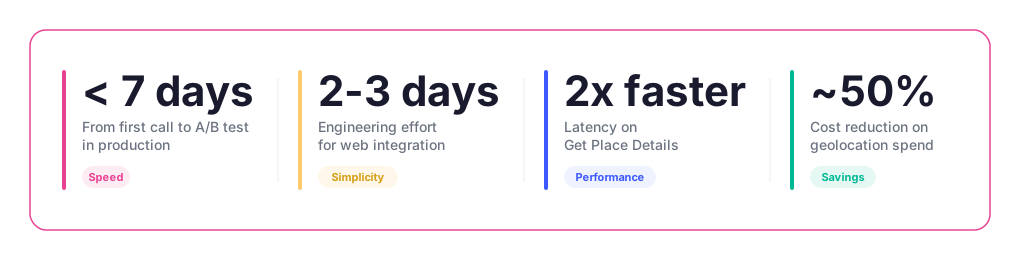
➜ From first call to production in under 7 days
➜ A/B test validated within a week
➜ 50% reduction on geolocation spend
Yespark at a Glance
Yespark is a parking rental marketplace operating across France and Europe. In June 2025, the company completed its merger with Zen Park: a full technical integration achieved in 4 to 5 months, resulting in a unified Ruby on Rails back-end and white-label mobile apps for iOS and Android.
With a strong culture of cost optimisation already in place, the engineering team turned its attention to the next big line item: geolocation. But price wasn't the deciding factor. The team needed a provider they could adopt quickly, without turning the switch into a project that would block the engineering roadmap.


The real barrier wasn't cost. It was the fear of a long migration.
Yespark was relying on Google Maps for autocomplete and geocoding across web, iOS, and Android, plus Mapbox for map tiles. The combined geolocation bill was a significant line item, and the team had limited visibility on how costs broke down by platform.
But cost wasn't the real blocker. Like most engineering teams, Yespark assumed that switching a core infrastructure provider meant documentation review, integration sprints, QA cycles, and staged rollouts before anything reached production. The kind of project that eats into the roadmap for weeks. For a parking marketplace where the search experience is everything, the perceived risk of disrupting something along the way made the decision even harder.
The question wasn't "is there a cheaper alternative?" It was "can we switch without derailing our roadmap?"
The fear of breaking the roadmap:
Most teams assume switching geolocation providers will take weeks of work and block their engineering priorities. That perception alone discourages them from even exploring alternatives.
Multiple providers to untangle:
Google for autocomplete and geocoding, Mapbox for map tiles. Two contracts, two consoles, two sets of billing logic. Replacing that setup felt like a heavyweight project.
Conversion at stake:
Any alternative had to deliver at least equivalent autocomplete accuracy to avoid losing parking bookings. There was no room for a "good enough" solution.
A significant cost, but not the main driver:
The geolocation spend was a major line item. But even with clear savings on the table, no team wants to commit to a project that disrupts sprint planning for a cost optimization.

2 to 3 days of integration. That's it.
Most teams expect switching providers to take weeks. Yespark estimated 2 to 3 days of engineering work for the web integration, and that's exactly how long it took.
The first meeting was on March 12, 2026. The teams mapped out the cost structure and agreed to start with autocomplete on web, with map tiles and mobile as potential next steps.
The documentation was clear enough that Yespark started coding right after the first call. The console was easier to navigate than Google Maps Platform, and an** Enterprise plan with no upfront commitment** meant Yespark could evaluate in real conditions before committing.
The API was compatible enough to wire a 50/50 traffic split into production. Yespark's engineers used Claude as their coding assistant, and it handled the Woosmap API without friction.
When questions came up, Woosmap support was there over chat or a quick call.
By March 19, one week after the first meeting, the A/B test had already produced enough data for a full debrief. In the time most companies take to book a second vendor call, Yespark had production data in hand.
When a client tells you the integration took 2 to 3 days, it reframes the entire conversation. The usual objection ("switching providers is a big project") disappears. It's not a big project. It's a couple of days of work and an A/B test. That's what we want every prospect to experience.


The A/B test results
The debrief on March 19 brought the Woosmap product and engineering teams together with Yespark to review the data. Four findings stood out.
Latency: 2x faster 🚀
Woosmap's median latency on Place Details was twice as fast as Google. On a parking marketplace where users type and browse in seconds, this has a direct impact on the search experience.
Fewer zero-result queries 🎯
Woosmap returned fewer "no result" responses than Google, meaning fewer users hitting dead ends during their search.
Cost: ~50% reduction 📉
Woosmap came in at roughly half the cost of the previous setup for equivalent capabilities, with clearer per-platform tracking.
Conversion: on par, if not better 📈
The A/B test confirmed what the team needed to know: conversion with Woosmap was on par with Google, if not marginally better. Yespark switched 100% of web sessions to Woosmap the same week.
The latency improvement, fewer dead-end searches, and equivalent (or marginally better) conversion gave the team the confidence to switch fully. Faster autocomplete means smoother browsing, and fewer failed queries mean fewer users dropping off mid-search. The A/B test didn't just validate the switch: it removed any remaining doubt.

When switching is easy, everything accelerates
The speed of the initial integration set the tone for the rest of the project. Once the A/B test confirmed the results, Yespark didn't need another round of approvals or a separate migration plan. The team integrated Woosmap Map into production on their website, replacing Mapbox for the map-based parking search. The integration of Woosmap Localities into the iOS and Android apps is currently underway.
This is the compounding effect of a simple integration: when switching is fast and low-risk, teams don't hesitate to go further. With a flexible plan, no upfront commitment, and an A/B test that could be reverted at any time, the team never had to bet the product on an untested provider. They validated first, committed later, and expanded naturally.
The switch also delivered a meaningful cost reduction (roughly 50% less than the previous Google + Mapbox setup), but it's worth noting: Yespark would never have captured those savings if the migration itself had been a multi-month effort. The cost reduction is a consequence of the simplicity, not the other way around.
"Woosmap doesn't monetise customer or end-user data. All data processing is privacy-first by design, making GDPR compliance simpler. Combined with a console that's easier to navigate, the team now has clearer visibility on costs across every platform."